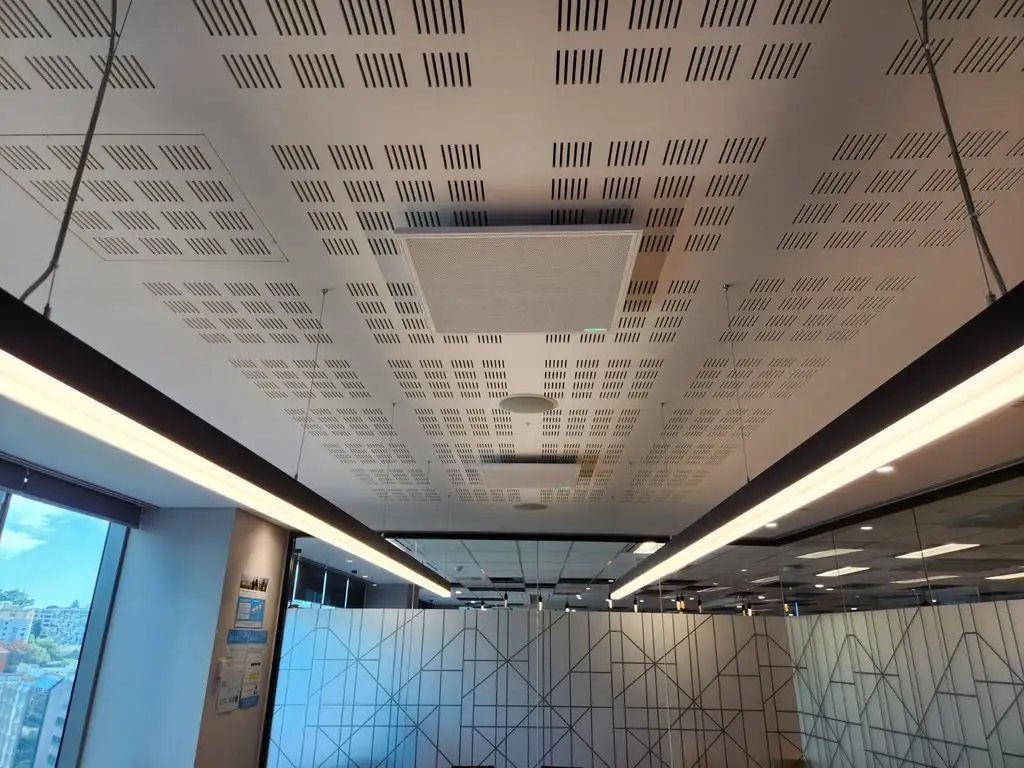
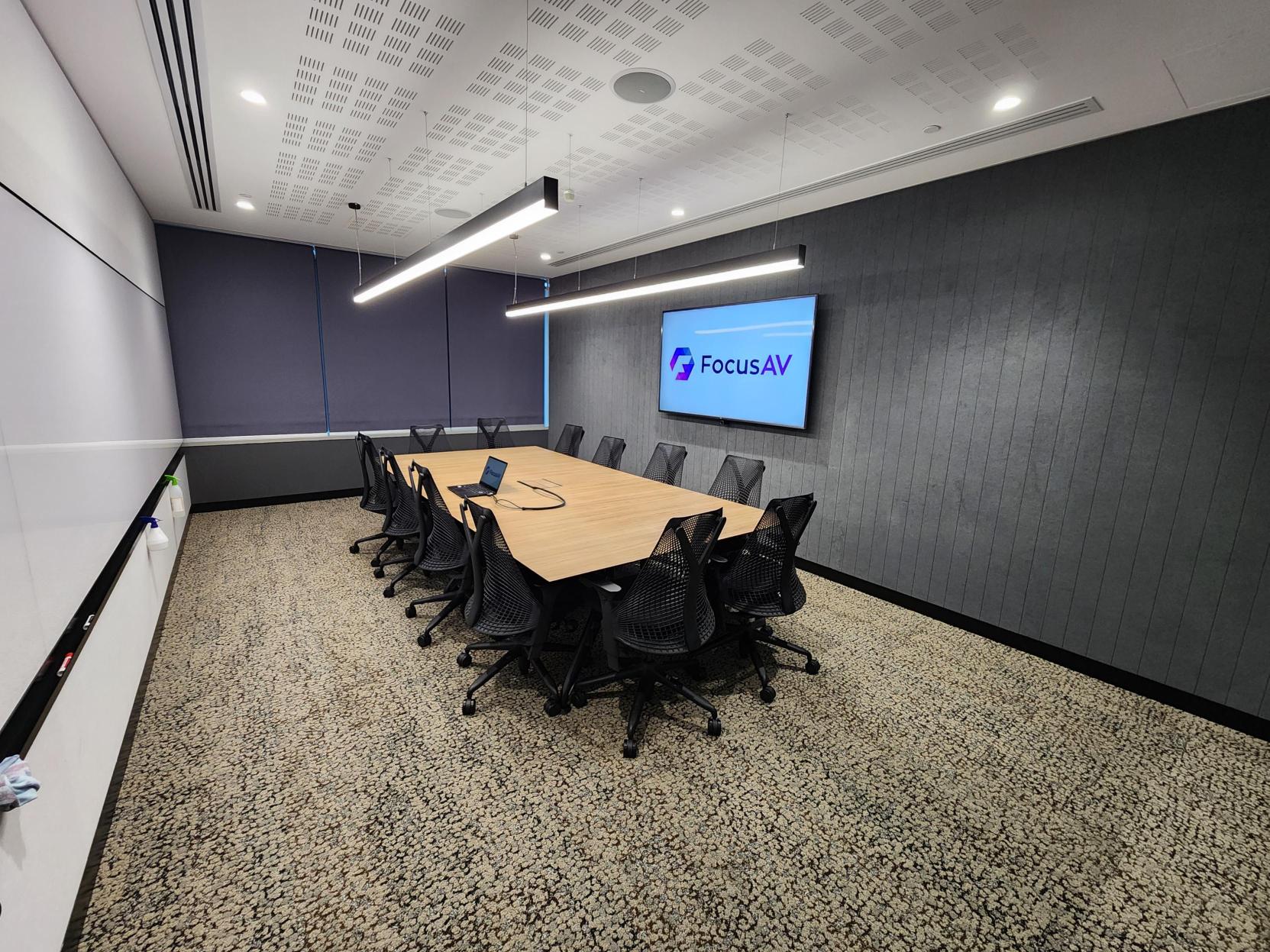
The handover is where it shows. A new boardroom, carpet adhesive still in the air: glass down one side, plasterboard down the other, a four-metre veneer table, and a ceiling microphone array that cost more than the chairs. Somebody dials in from a desk two floors up to test it. Thirty seconds later they say the sentence we have been hearing in Perth offices for fifteen years.
Sorry — can you say that again?
The reflex is to blame the microphone, and the market is delighted to help. Nearly every audio product launched in the last three years leads with a machine-learning claim: adaptive beamforming, AI noise suppression, voice isolation, automatic gain that follows the talker around the table. Buy the newer array, the argument goes, and the room stops mattering.
It does not stop mattering. The position we will defend for the rest of this article is blunt: in a boardroom, the room is a component of the audio system, and it is the only component nobody prices until the complaints start. An algorithm can strip out the air-conditioning. It cannot strip out the room, because what the room does to a voice is make more of that voice — and every denoiser on the market is built to keep voices. That is why acoustic treatment for boardrooms is not a decorating decision made after the AV budget is spent. It is the first line of the audio design.
The room gets to the microphone first
Sit at the far end of a hard-surfaced boardroom and speak. Two things travel toward the microphone. The first is the direct sound: the pressure wave that goes mouth to capsule in a straight line. The second is everything else — the same sentence, milliseconds later, off the table, the glass, the ceiling, the whiteboard, the display, and then off those surfaces again, arriving as a dense, smeared copy of what you just said.
The ratio between those two is the whole game, and distance decides it. Direct sound obeys the inverse square law: every doubling of the talker-to-microphone distance drops it by roughly 6 dB. The reflected field does not behave that way at all. Once a room is reverberant, that energy is spread fairly evenly through the space, so it stays at much the same level whether the mic is 400 millimetres from your mouth or 2.5 metres above your head. Move the microphone further away and you lose direct voice while keeping every reflection. Past a certain distance — acousticians call it the critical distance — the microphone is hearing more room than person.
In an untreated glass-and-plasterboard boardroom, that distance is uncomfortably short. It is often nearer to a metre than three, which means a flush ceiling array over a four-metre table is working almost entirely in the reverberant field, competing with a copy of the very sound it is trying to capture.
Now consider what noise suppression is trained to do. It learns the statistical difference between speech and things that are not speech: fan noise, keyboard clatter, traffic, the rattle of a trolley in the corridor. Feed it reverberation and the model has a problem, because reverberation is not noise. It is speech — the correct speaker, the correct words, arriving a few milliseconds late and layered over itself. Dereverberation is a genuinely different and much harder processing job, and even when it is applied, it is subtractive: it can suppress a smeared signal, but it cannot restore consonants the room already buried. The s, t and k sounds that carry intelligibility are short, quiet and high-frequency. They are the first casualties, and once they are gone, no amount of processing invents them back.
This is the part the product marketing quietly skips. Acoustic echo cancellation — the far end hearing itself come back — is a solved problem, and has been for years. Steady background noise is largely solved. Room reverberation is not solved, and is not close to solved, because it is not a signal-processing problem. It is a construction-materials problem that happens before the signal exists.
The Half-the-Distance Rule
Everything above collapses into one rule of thumb we use on site, and we would rather other people used it too:
The Half-the-Distance Rule: before you spend another dollar on processing, spend it on distance. Halving the distance between a talker and the microphone adds about 6 dB of direct voice and adds nothing to the room. No noise-suppression setting on the market gives you 6 dB for free.
It is a crude number and it is deliberately crude, because it is meant to be usable in a design meeting with a floor plan on the table and no measurement gear in the room. Applied honestly, it changes decisions.
It says that a tabletop beamforming microphone at 500 millimetres will, all else equal, deliver a materially better direct-to-reverberant ratio than a ceiling array at two metres — and that the ceiling array only closes that gap when the ceiling above it has been treated and the array’s beams have been aimed at seats rather than at the general idea of a table.
It says that in a fourteen-seat room, the argument between one array and two is usually less important than the argument about where people sit relative to whichever array you buy.
And it says something uncomfortable about aesthetics. Table microphones win on physics and lose on photographs. Ceiling arrays win on photographs, on clear tables, on rooms whose furniture moves weekly, and on clients who will not tolerate a cable well. Those are legitimate reasons to go up — Parle ceiling microphones exist because they are the right answer in plenty of rooms, and we specify them often. The rule is not “never mount a mic in the ceiling”. The rule is: if you take the distance penalty, you have to buy the room back with treatment. Choosing the ceiling and skipping the panels is choosing to lose twice.
What acoustic treatment for boardrooms actually buys you
Three genuinely different physical faults arrive wearing the same complaint — “the room sounds terrible” — and they have three different fixes. Confusing them is the most expensive mistake we see in Perth fit-outs, because it leads organisations to buy the wrong remedy and then conclude that acoustics do not work.
| The complaint | The actual fault | How it is measured | What fixes it | What will not |
|---|---|---|---|---|
| ”There’s an echo on every call” | Reverberation inside the room | RT60 — untreated glass-and-plasterboard rooms routinely exceed 1 second against a 0.4–0.6 s target for boardrooms | Absorption at the ceiling and the first-reflection points on the side walls | More microphone channels; higher noise-suppression settings |
| ”You can hear our board meeting in the corridor” | Sound transmission between spaces | Sound reduction across the partition — including flanking over the ceiling line | Mass, sealed junctions, barriers above the ceiling grid — building work | Absorption panels inside the room |
| ”Nobody out there can concentrate” | Distraction in the open plan | Distraction distance under ISO 3382-3 — the distance at which speech becomes unintelligible enough to stop pulling focus | Absorption plus screens plus masking, together | Absorption on its own |
That third row deserves its own note, because it is the one that surprises people. ISO 3382-3, the international standard for open-plan office acoustics, does not judge a floor on how quiet it is. It judges it on how far a conversation stays intelligible — the distraction distance — because intelligible speech is what breaks concentration, not volume. Peer-reviewed field work on open-plan offices has consistently found that privacy improves when absorption, screen height and masking level rise together, and that absorption alone leaves the number stubbornly high. That is the evidence base behind sound masking as a discipline, and it is why we draw treatment and masking on the same plan rather than selling one as a substitute for the other.
Inside the boardroom, though, row one is the money. Absorption at roughly 20–40% of wall and ceiling area, placed where the reflections actually are, is what drops a room from over a second of reverberation to the 0.4–0.6 seconds where consonants survive the trip to the microphone. The ceiling is almost always the largest untreated surface and the highest return per square metre, which is why 3D acoustic ceiling tiles and rafts do more work than an equivalent area of wall panels. Quietspace panels at seated ear height on the side walls handle the rest. Both are built from recycled PET, which is a nice-to-have; the reason we specify them is that they measure.
Boardroom soundproofing is a different purchase from acoustic panels
Every month, someone calls us about soundproofing a boardroom and describes a problem that panels will not touch: confidential discussions audible in the lift lobby, or the meeting next door bleeding through. Absorption inside a room reduces the reflected energy inside that room. It does very little to stop sound crossing a wall, and nothing at all to stop it crossing over one.
That last path is the one that catches out otherwise excellent fit-outs. Plenty of Perth office partitions stop at the ceiling grid, so speech simply travels up, across the shared plenum, and back down into the next room. You can line that boardroom with felt to the point where it sounds like a recording studio and still be perfectly audible in the meeting beside it. The honest fix is construction: mass, sealed junctions, and barriers above the ceiling line. Where the base building or the programme makes that impractical, masking outside the room is the pragmatic answer — a tuned, unobtrusive ambient level that makes whatever leaks unintelligible a few metres from the door.
We say this to clients before they spend, because getting it wrong is not a small error. Treatment is a same-week job on a finished room. Isolation is builders, dust and programme. Those two things belong in different columns of a budget, and an integrator who lets you buy the first while describing the second is not doing you a favour.
Where the algorithms genuinely win
The counter-case is real, and pretending otherwise would be dishonest.
Beamforming is not marketing. Steering a pickup pattern at a seat and rejecting energy arriving from other directions genuinely improves the direct-to-reverberant ratio — it is one of the few processing techniques that attacks the actual problem rather than masking it. Modern noise suppression is excellent at what it targets, and the difference between a 2019 video bar and a 2026 one in a mediocre room is not subtle. Automatic mixing, per-seat gating and adaptive gain have quietly removed a whole category of complaint.
The fair conclusion is not that the technology fails. It is that the technology has raised the floor, and raising the floor is exactly what makes the remaining gap so visible. Small huddle rooms with soft furnishings and a video bar 1.5 metres from the nearest face now sound fine with no treatment at all, and we will happily say so rather than sell panels nobody needs. That is a genuine change in the last five years, and it has narrowed where treatment is worth spending on.
It has narrowed it toward exactly the rooms that matter most: the big ones. Long tables, hard architectural finishes, full-height glazing, distant microphones, and the meetings the organisation cares about. A Microsoft Teams Rooms boardroom with a $25,000–$60,000 AV budget is precisely the room where the physics is hardest and where the algorithms have the least headroom left to give you. Our boardroom work at CBH Group and at Hub Australia’s Nine the Esplanade both landed there: the ceiling was doing acoustic work long before anyone looked at the microphone specification.
The handover test
Go back to that new boardroom, before anybody signs the practical completion certificate. Stand in the middle, clap once, hard, and listen. A dry slap that dies immediately means the room is ready for the technology. A metallic ring or a tail that hangs means the room will be fighting every microphone you install in it, on every call, for the next ten years — and no firmware update will change that.
Then do the second half, which almost nobody does: close the door, have someone read a page of text aloud inside at normal volume, and stand in the corridor. If you can follow the sense of the sentences, you have an isolation problem, and no amount of panelling inside will fix it.
Two tests, four minutes, no instruments. They will tell you more about how that room will perform than the entire audio section of the tender response.
The order to spend in follows from there, and it is the reverse of how most projects are run: get the room right, then choose the microphone, then let the processing do the last ten per cent it is genuinely good at. Do it the other way around and you buy a very intelligent device and put it in a stairwell.
If you are specifying a boardroom now — or you already have one that photographs beautifully and performs badly on every call — that is the conversation to have before the panels or the microphones are ordered. Focus AV designs and installs boardroom acoustic treatment in Perth alongside the AV itself, measured against a reverberation target rather than promised against one, and coordinated with the meeting room AV design so the panels end up where the microphones actually need them.