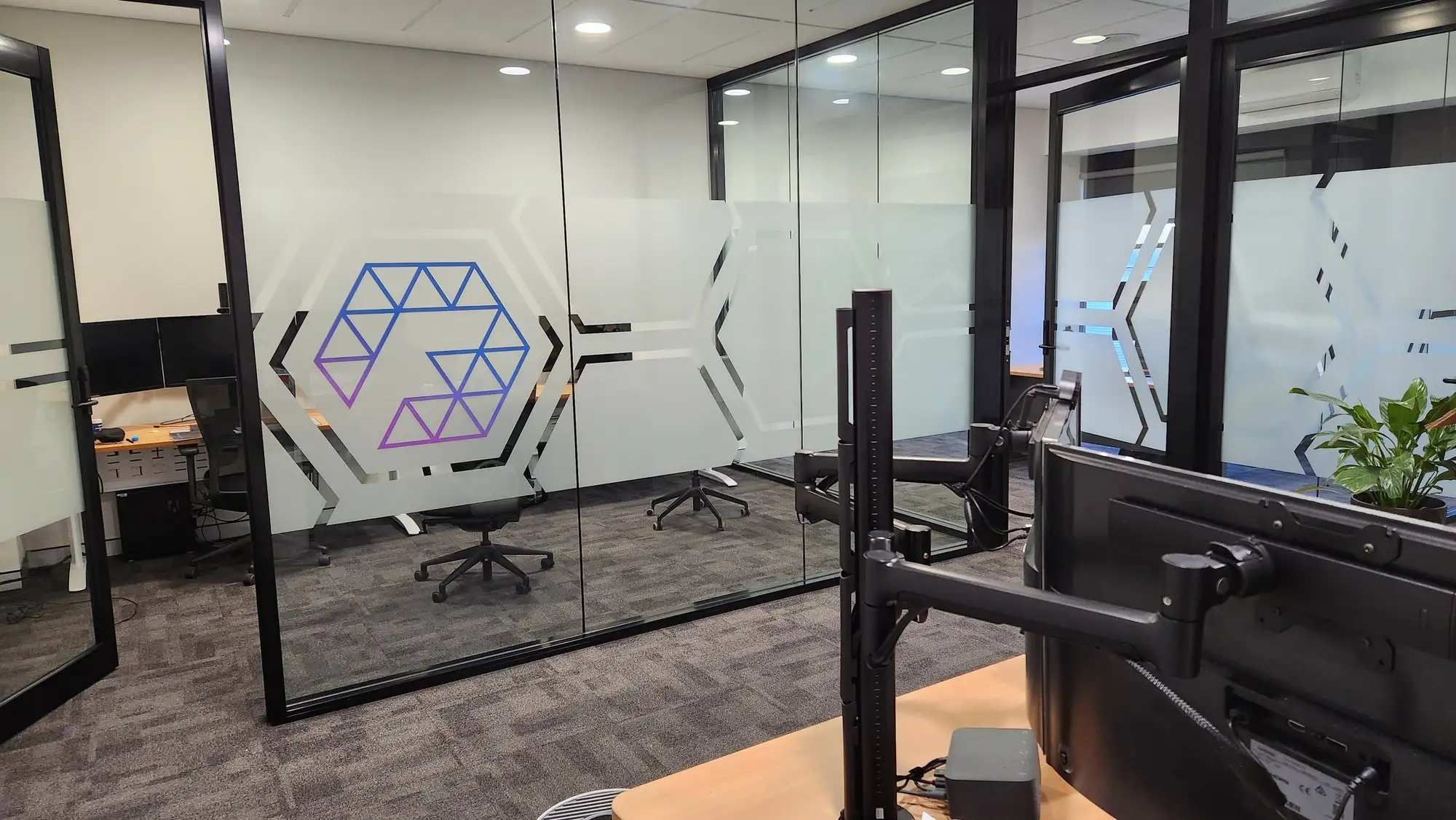
Sound Masking
Privacy you can't hear.
Sound masking adds a precisely engineered ambient background that makes distant speech unintelligible — so conversations stay private, open plan stays calm, and nobody notices the system doing it.
What masking actually is
Not white noise. Not music.
Masking isn't white noise (equal energy across the spectrum — annoying) and it isn't background music (has content — even more distracting). It's a shaped, low-level ambient sound that lives exactly where human speech does on the frequency spectrum, delivered evenly from an array of small ceiling emitters.
Because the sound matches the shape of speech, it doesn't hide the meeting you're in — it hides the meeting three desks away. Nearby conversation stays perfectly intelligible; distant conversation becomes an unresolvable hum you never quite hear.
Set it up well and people forget it exists within a week. Switch it off and everyone asks why the office suddenly feels so exposed — which is the strongest possible endorsement of a system designed to be forgotten.
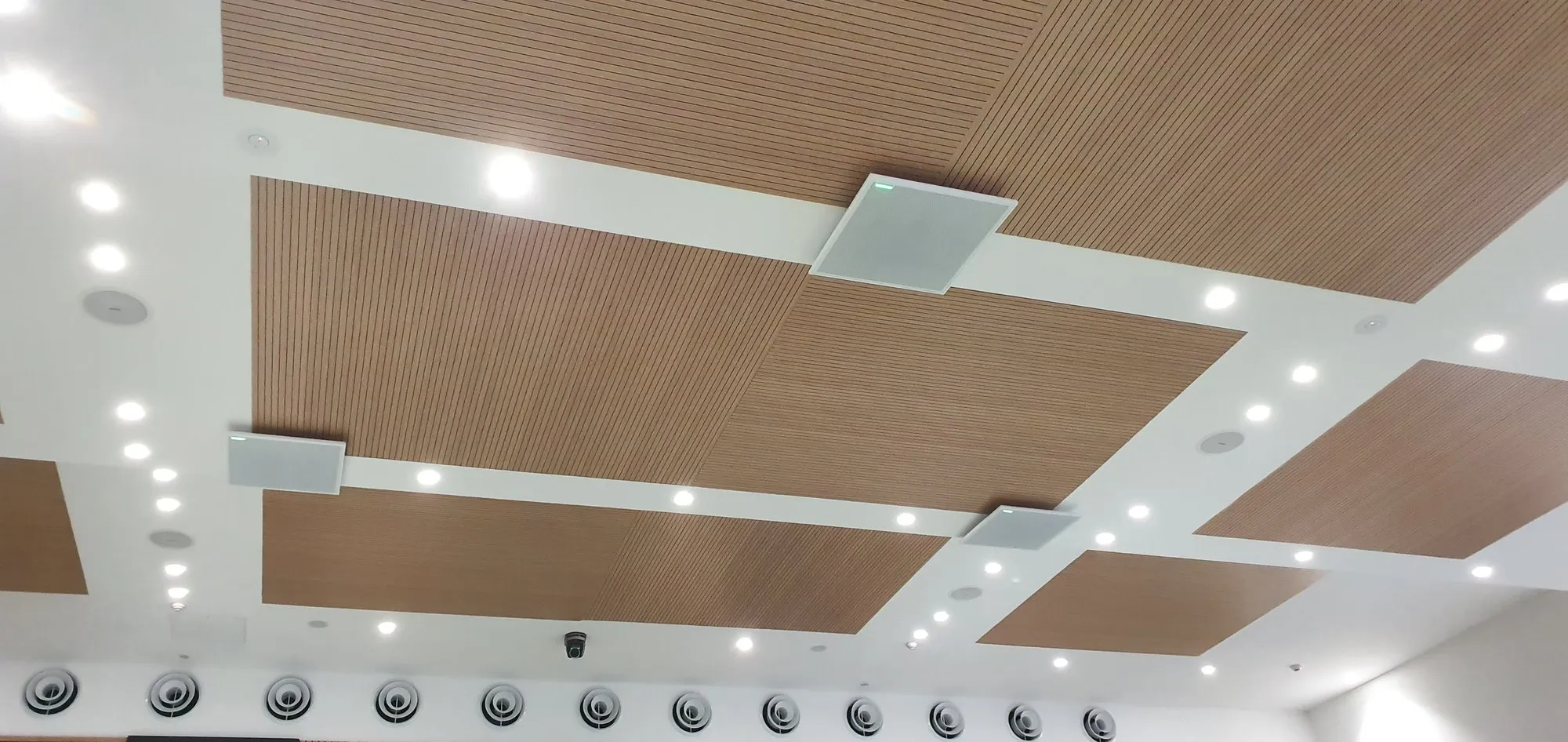
The quiet office myth
Too quiet is why everyone can hear you.
The counter-intuitive truth of office acoustics: silence is the problem. In a very quiet office, one phone call carries thirty metres, the salary conversation in the boardroom becomes floor gossip, and every keyboard tap lands because there's nothing to soften it. The library effect: a whisper isn't private.
Sound masking raises the ambient background evenly and precisely — tuned to speech frequencies — so speech intelligibility drops off with distance. Café conversations feel private for exactly this reason: the surrounding hum keeps other people's words at the edge of understanding.
Focus AV designs and installs masking with Biamp Cambridge, the reference platform — zoned per space, commissioned by ear and by meter, and integrated with the acoustics work on the same drawing.
How it works
Raise the floor, not your voice.
Sound masking works by adding a precisely shaped, barely noticeable ambient sound to a space — lifting the background level just enough that speech from a distance falls below the point where the brain can resolve words. Nothing is blocked or absorbed; the silence that carried the conversation simply isn't there any more.
Intelligibility is a ratio
You understand speech when it arrives louder than the background at your ear. In a very quiet office that ratio stays favourable over absurd distances — which is why one phone call can be followed word for word from twenty metres away.
Masking lifts the background
An array of small ceiling emitters raises the ambient level a few decibels — but only in the frequency bands where human speech lives, shaped so the ear reads it as air handling rather than noise. Even coverage is the whole game: no loud spots, no gaps.
The radius of distraction shrinks
Your own conversation stays perfectly clear — the people in it are close, so their ratio is untouched. But speech from fifteen metres away drops below the intelligibility threshold and becomes an anonymous murmur. Distraction collapses from a whole floor to a few metres.
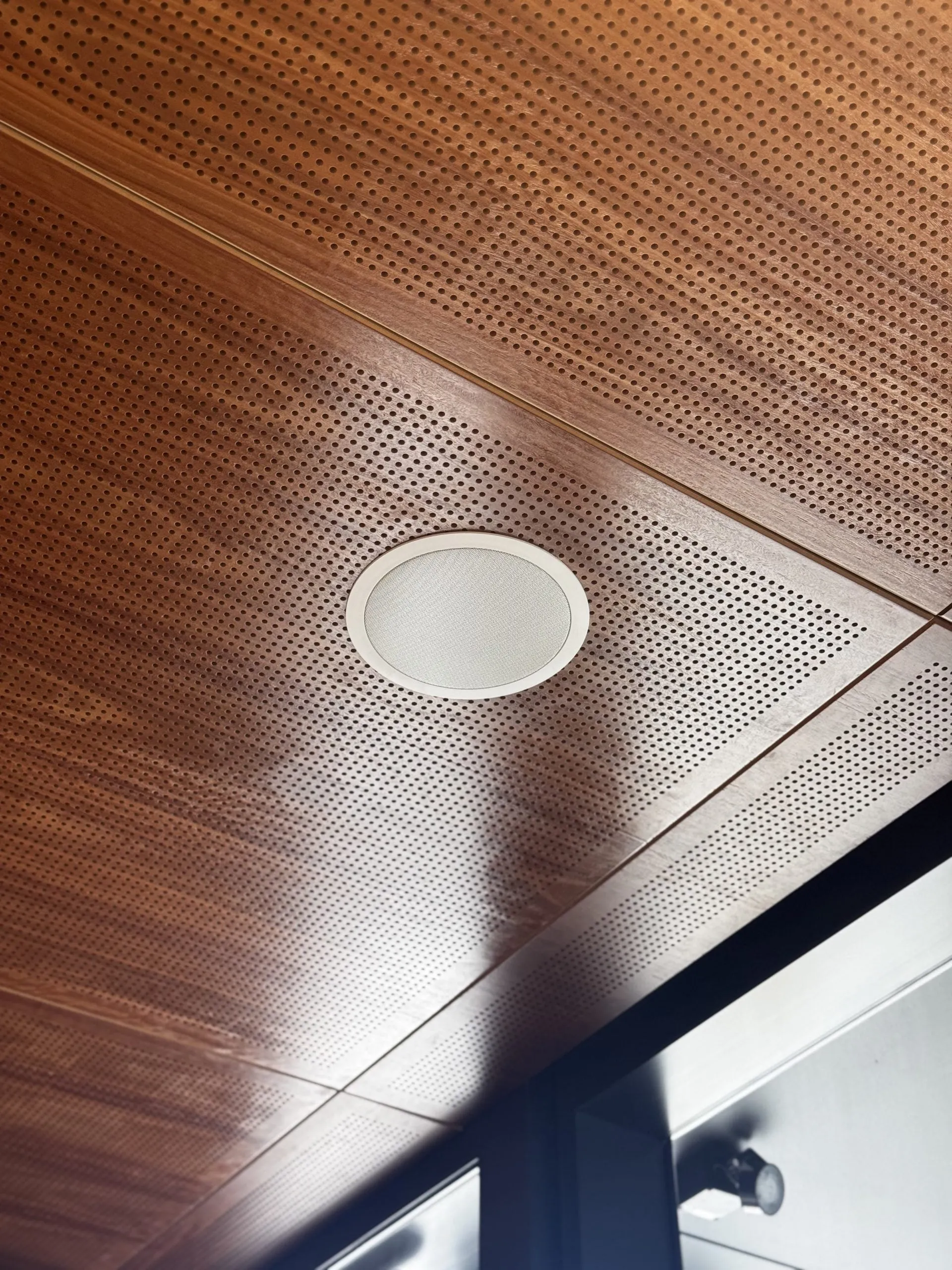
Know the difference
Masking, treatment, white noise machines.
Masking reduces how far speech stays intelligible between people. Acoustic treatment reduces echo within a room. Consumer white noise machines attempt the first job and do it badly — one untuned source can never cover a floor evenly. Offices with both echo and privacy symptoms need treatment and masking designed together.
| Sound masking | Acoustic treatment | White noise machine | |
|---|---|---|---|
| What it does | Raises the ambient floor with a tuned spectrum so distant speech loses intelligibility | Absorbs reflections so a room stops echoing and speech stays crisp | Emits an untuned hiss from a single point |
| The problem it solves | Speech privacy and open-plan distraction — sound travelling between people and spaces | Reverberation, harshness and meeting fatigue — sound behaving badly within a room | Mostly the feeling of having done something about it |
| What's installed | Small emitters on a ceiling grid, a processor, independent zones — nothing visible | Panels, rafts, baffles and screens on the room's surfaces | A box on a shelf |
| What you hear | Nothing you'd name — the space just feels calmer and conversations stop carrying | Your own voice, cleaner — the room stops answering back | Hiss — loud beside it, useless across the room |
| Coverage and tuning | Engineered per zone, commissioned by meter and by ear, verified in writing | Calculated from measurement to a target reverberation time | None — one volume knob for an entire floor |
Open plan
The open-plan fix that isn't construction.
Masking is the most effective retrofit for open-plan noise because it attacks the real problem. Surveys of open-plan workplaces keep landing on the same finding: the top distraction isn't noise level — it's intelligible speech. Your brain can ignore a hum; it cannot ignore words. As long as the conversation three pods away is resolvable, part of your attention is transcribing it whether you want to or not.
Masking removes the words without touching the fit-out: no construction, no lost desks, installed above the ceiling in days, usually after hours. It pairs naturally with acoustic treatment — baffles and desk screens calm the roar, masking dissolves the speech — and the combination is what makes a dense floor genuinely workable.
It also future-proofs the layout. Zones are software, so when the floor plan changes — more pods, a new quiet zone, a team that grew — the system is re-tuned, not rebuilt.
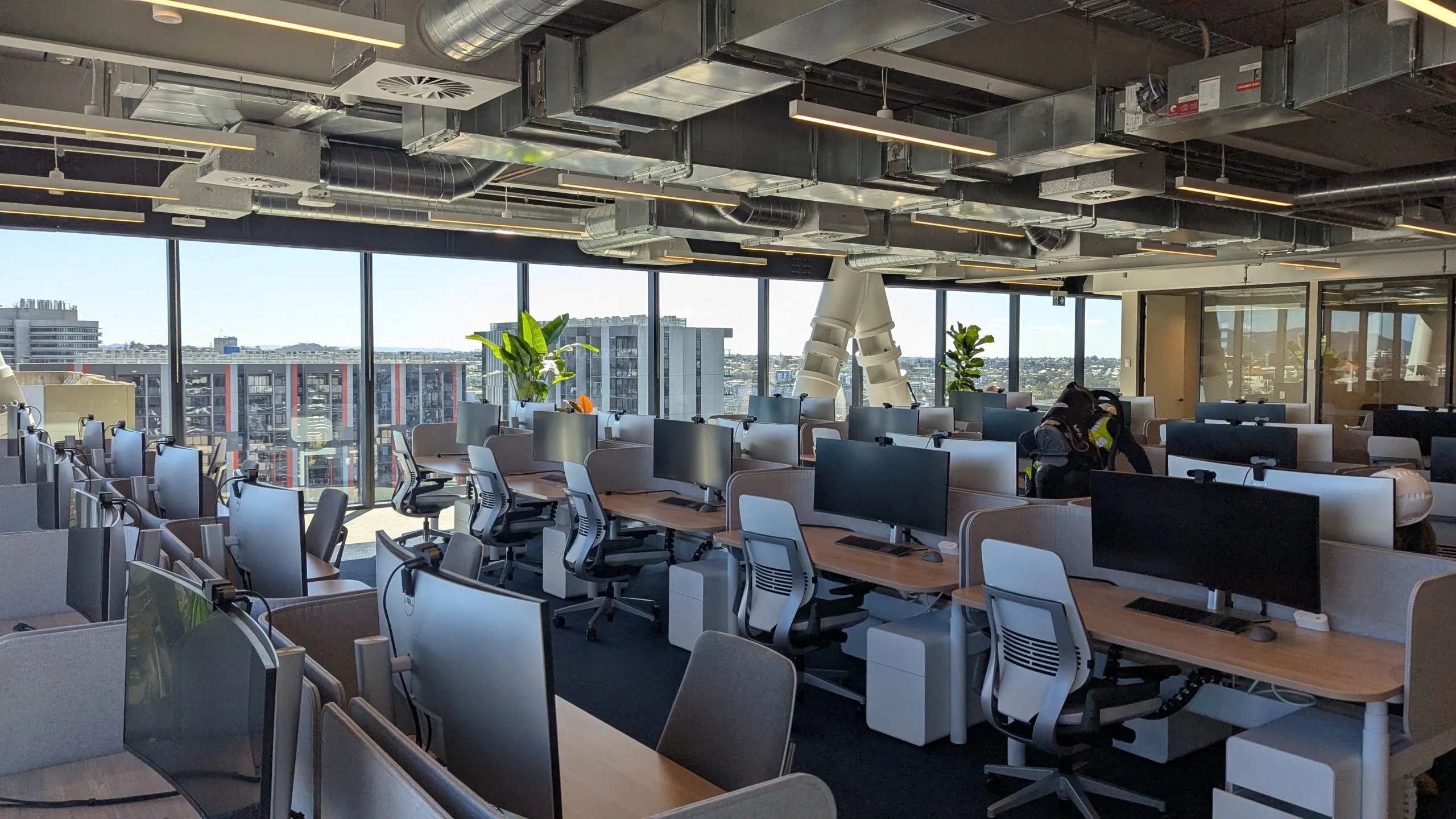
Speech privacy
Where overheard speech is a liability.
For legal, medical, financial and HR conversations, speech privacy isn't a comfort feature — it's a professional obligation. Australian privacy principles expect reasonable steps to protect personal information, and that includes conversations being overheard. A commissioned masking system, with its written verification report, is one of the most defensible steps a workplace can point to.
Legal and professional practices
Client conversations are privileged, and partner offices with glass fronts leak. Masking tuned to a confidential-grade privacy target makes a normal speaking voice unintelligible a few metres outside the room — protection the fit-out's walls were never going to provide on their own.
Medical and allied health
Patients in the waiting room shouldn't hear the consultation next door, and privacy regulators expect practices to take reasonable steps to make sure they don't. Masking through waiting areas and outside consult rooms is the most cost-effective way to meet that expectation in an existing clinic.
HR, payroll and management
Salary reviews, grievances, restructures — the conversations that do the most damage when overheard usually happen in ordinary meeting rooms off ordinary corridors. Masking those corridors is quiet insurance: the discussion stays in the room even when the door seal doesn't hold it.
By space type
Every space has its own privacy target.
Masking isn't one dial. Open plan needs one thing, a legal floor needs another. Pick a space type below and see the privacy target, the masking level and the coverage strategy we'd design for it.
The problem
Ninety desks, one big volume. The salary conversation in the corner meeting room, the mid-morning stand-up two clusters away, and the phone call at the desk next to yours all fight for the same air. Nobody can focus.
Privacy target
0.20
Speech Privacy Class B
Masking level
44–46 dBA
A-weighted
Emitter density
1 : 15 m²
per zone
Coverage strategy
- Even direct-field coverage across the full floor plate — no gaps, no hot spots.
- Consistent spectrum from cluster to cluster so people moving around never sense a change.
- Slightly reduced level over quiet zones (focus pods, reading nooks) so those spaces still feel calm.
- Soft-start commissioning over 3–5 days — level ramps up so gently that nobody notices it arrive.
Why it matters: Below Privacy Index 0.20, speech at 5 metres becomes an unresolvable hum — you know somebody's talking, you can't tell what they said. That's the target for open-plan concentration.
The system
What a masking system actually consists of.
Four parts: small direct-field emitters spaced evenly through the ceiling, a processor that generates and shapes the masking spectrum, zoning so every space runs its own level, and commissioning — the on-site tuning that separates a system nobody notices from a system everybody complains about.
Emitters — the invisible layer
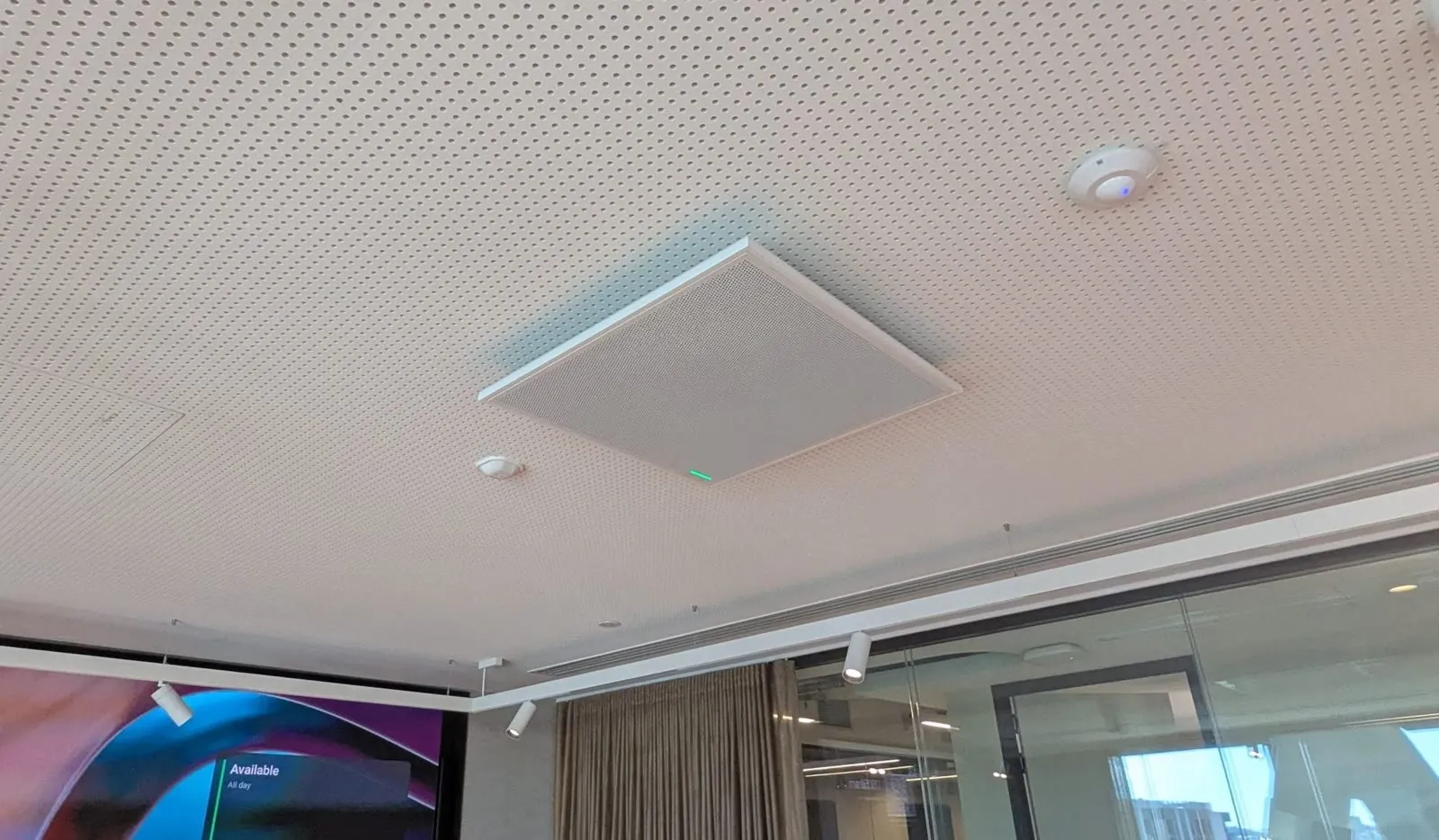
Small loudspeakers roughly every three metres, above or flush with the ceiling, each covering a modest area at low level. Density is the point: many quiet sources make coverage even, where a few loud ones would create hot spots people notice and dead spots where privacy fails.
Processor — the shaped spectrum
A networked controller — we build on Biamp Cambridge — generates the masking signal and contours it to the frequencies of human speech, so a few decibels do the work of many. The same processor can overlay paging and background music where you want them.
Zones — one floor, many targets
Open plan, boardrooms, corridors, quiet rooms and reception each get an independent level and spectrum. A legal corridor might run confidential-grade masking while the library corner two zones over barely whispers — and re-zoning later is software, not rewiring the ceiling.
Commissioning — meter, ear, report
We measure every zone with a class-1 sound level meter, walk the floor listening, and ramp the level in softly over several days so nobody notices it arrive. The result is documented in a written report — the number and the feel both have to be right before we sign it off.
Budget
What sound masking costs in Perth.
Masking is priced per square metre of coverage, and the per-metre rate falls as the area grows. As a guide only: a typical single floor lands in the low tens of thousands of dollars installed and commissioned, including the processor and design work. Every quote follows a floor walk — these numbers frame a conversation, not a contract.
| Cost driver | Why it moves the number |
|---|---|
| Floor area | The main lever — emitter count scales with square metres. Larger floors cost more in total but noticeably less per metre. |
| Number of zones | Every independently tuned space — each boardroom, corridor and quiet room — adds processing and commissioning time. |
| Ceiling construction | A standard tile grid is the quick case; plasterboard, open soffits and heritage ceilings need different emitters and longer installs. |
| Privacy target | Confidential-grade zones for legal and medical spaces use tighter emitter spacing than general open-plan comfort masking. |
| Paging and music overlay | Optional — the same ceiling infrastructure can carry announcements and background music, which usually beats installing a separate system. |
Acoustics-first workplaces, delivered.

The pairing
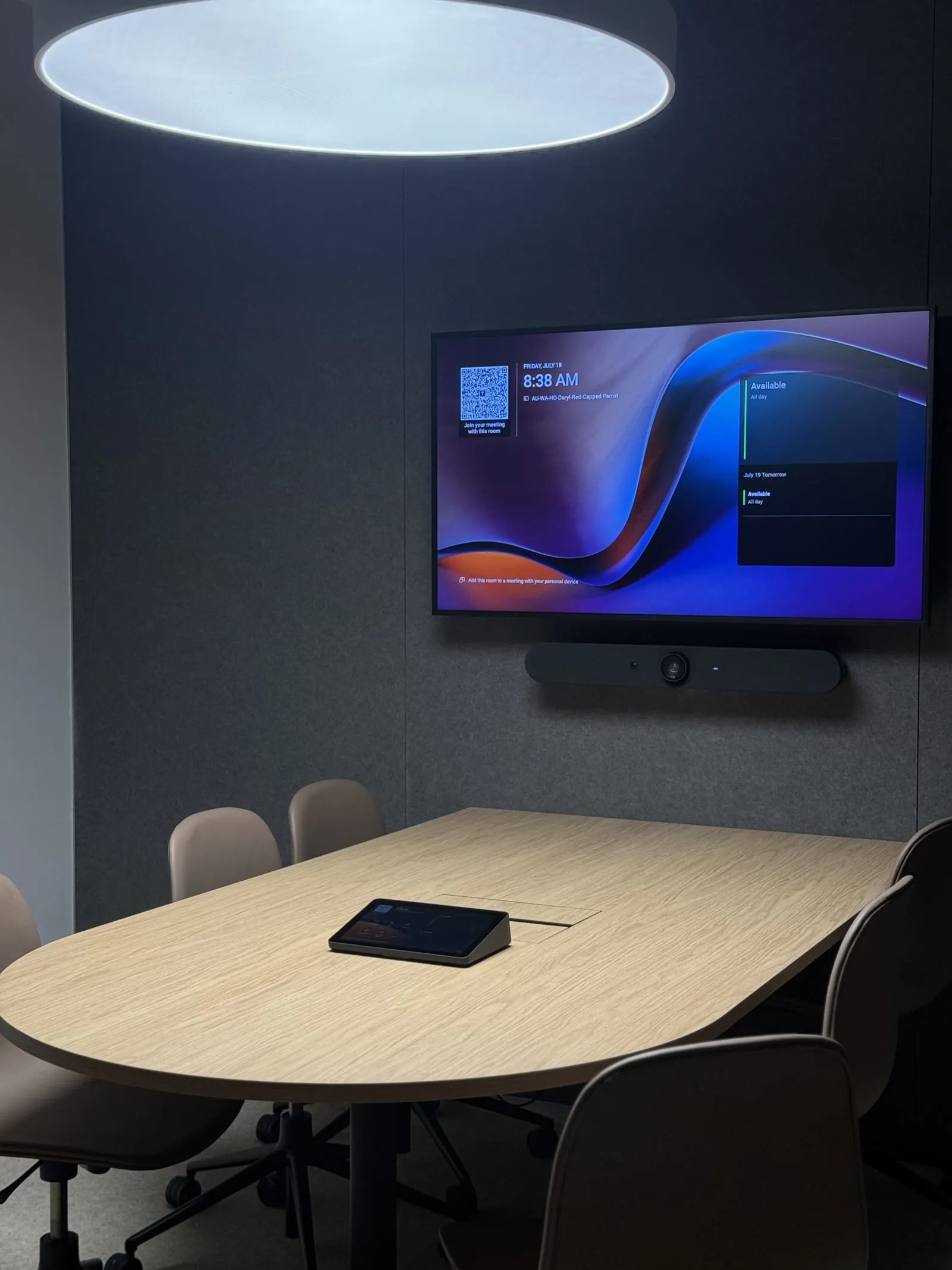
Treatment calms the room. Masking protects the words.
Sound masking and acoustic treatment solve different problems — and both matter in the same fit-out. We design them together, which is why our rooms feel calm and our meetings stay private.
- Biamp Cambridge Qt
- Direct-field emitters
- Zoned & tuned
- Paging & music integrated
- Class-1 SPL commissioning
- Legal & medical spec
Proof
Delivered. Documented.
The whole room
One design. One schedule. One accountable partner.
Straight answers.
Is sound masking just white noise?
No. White noise puts equal energy across every frequency and genuinely grates on people. Masking uses a shaped spectrum matched to the shape of human speech, delivered evenly through dedicated ceiling emitters and tuned per zone. Done properly, people don't hear the sound — they notice the office feels calmer.
Will staff find it distracting?
Systems are commissioned with a soft-start over several days so people never notice it arriving, and they sit at conversational-comfort levels (typically 42–48 dBA). The consistent experience: within a week nobody hears it, and when it's ever switched off everyone asks why the room suddenly feels exposed.
Masking or acoustic treatment — which do we need?
Different jobs. Treatment reduces echo within a room. Masking reduces intelligibility between spaces. Open-plan distraction and speech privacy are masking problems; harsh, echoey boardrooms are treatment problems. Most workplaces with both symptoms benefit from both — designed together on the same drawing, which is exactly how we do it.
Does sound masking actually work?
Yes — it's mature, measurable technology, standard in North American corporate and government fit-outs for decades. Privacy is quantified with a before-and-after measurement (privacy index), so the result is verified rather than promised. The most convincing proof is the switch-off test: turn a commissioned system off and within minutes the floor feels exposed and every conversation suddenly carries.
Is a white noise machine the same as sound masking?
No. A consumer white noise machine is a single untuned source with the wrong spectrum — loud near it, useless ten metres away, and genuinely irritating in between. An engineered masking system uses dozens of small emitters on a ceiling grid, a processor shaping the sound to match human speech frequencies, and zone-by-zone tuning so coverage is even everywhere and audible nowhere.
Can sound masking be too loud?
Yes — and that's the failure mode behind most masking horror stories. Pushed above roughly 48 dBA, masking stops being invisible and becomes its own annoyance. Proper commissioning holds each zone at conversational-comfort levels (typically 42–48 dBA), ramps in over several days, and is verified by meter and by ear. The system you notice is a system that was tuned badly.
Do we still need acoustic treatment if we install masking?
Often, yes. Masking doesn't reduce echo — a harsh, reverberant boardroom will still sound harsh with masking outside the door, because those are different problems. Treatment calms the sound within a room; masking protects speech between spaces. Workplaces with both symptoms get the best result when both are designed together, which is how we deliver them.
Can it retrofit into an existing ceiling?
Yes — emitters install above or in most ceiling types (recessed tile grid, plasterboard, open soffit). A typical floor is installed and commissioned in days, usually after hours, with minimal disruption.
How is it commissioned?
On-site with a class-1 sound level meter and a walk-through by ear. We measure the ambient spectrum in every zone, tune the emitters and processor until masking sits at the target level in every part of the floor, then verify with a walk. Every commission ends with a written report.
What does it cost in Perth?
Roughly per square metre of coverage — a mid-size floor (say 1,000 m²) typically lands in the low tens of thousands installed and commissioned, including the processor and the design work. Multi-tenant fitouts scale down per m².
Conversations travelling too far? Let's fix it quietly.
We'll walk the floor, find where privacy leaks, and design a masking system nobody will ever notice — which is the point.