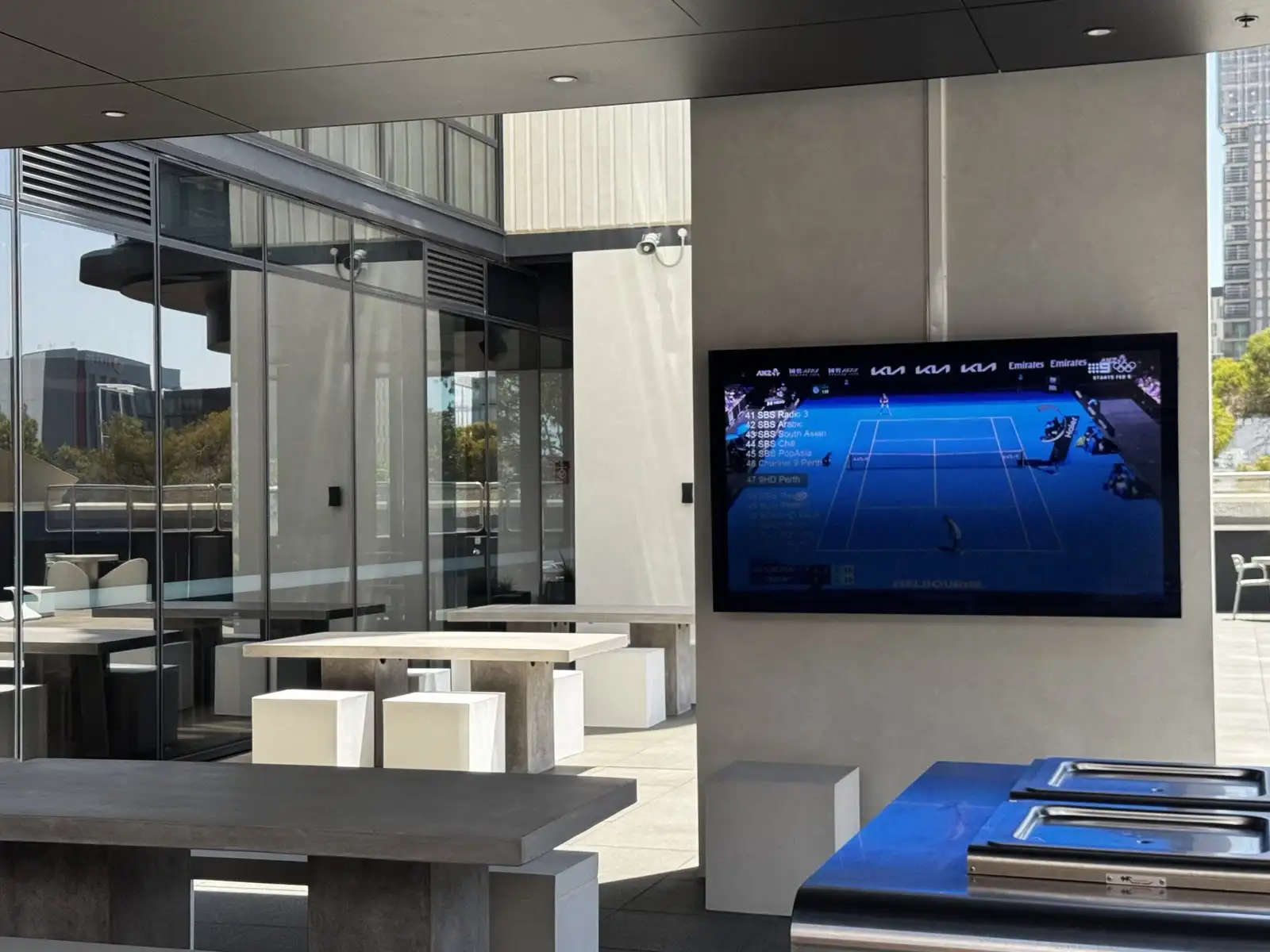
MATV Systems
Clean signal, every outlet.
MATV distributes broadcast television through a building the reliable, no-drama way. Focus AV designs and installs commercial antenna systems for apartments, hotels, aged care and venues across Perth.
What MATV actually is
One antenna, every outlet.
MATV — master antenna television — takes one properly engineered antenna and headend and distributes clean broadcast signal to every TV outlet in the building over dedicated coax. It's the right answer for plenty of buildings: apartments, motels, clubs, aged-care homes and workplaces that just need reliable TV without network complexity.
Done badly (and we see it weekly), it's ghosting, dropouts and one flaky splitter taking out a whole wing. Done properly, it's a signal survey, a balanced amplifier design, quality cable and terminations, and a documented system a sparkie can trace in ten years.
Focus AV installs and repairs both MATV and its network-based successor IPTV — and we'll tell you honestly which one your building needs. Sometimes the answer really is the antenna.
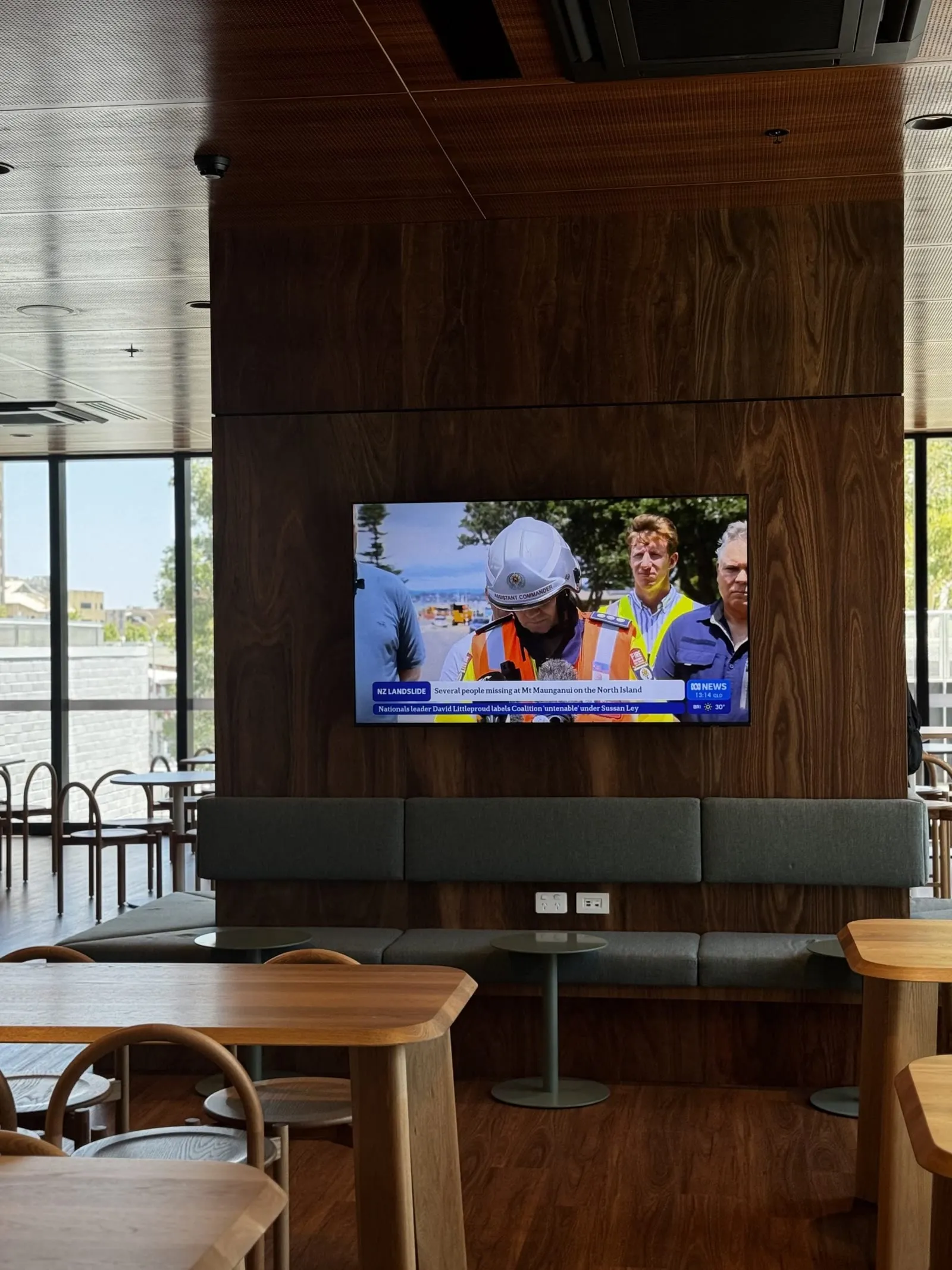
The unglamorous essential
TV that just works, floor after floor.
Nobody praises a building's MATV — until unit 47 gets pixelation every windy evening and the strata inbox catches fire. Broadcast distribution is invisible when engineered properly and unforgettable when it isn't.
Proper MATV is a signal engineering job: headend amplification and filtering, balanced splits calculated per outlet, quality cabling, and documentation that lets the next technician understand the building in minutes.
Focus AV installs and rescues MATV across Perth — and when a building's needs outgrow coax (in-house channels, hundreds of screens, per-screen control), we'll tell you honestly when IPTV is the better answer. We do both, so the advice is straight.
Under the bonnet
How an MATV system actually works.
An MATV system captures broadcast signal once — at a properly engineered antenna or satellite head-end — then amplifies, balances and distributes it over coaxial cabling to every TV outlet in the building. Four stages, and every one of them is measurable.
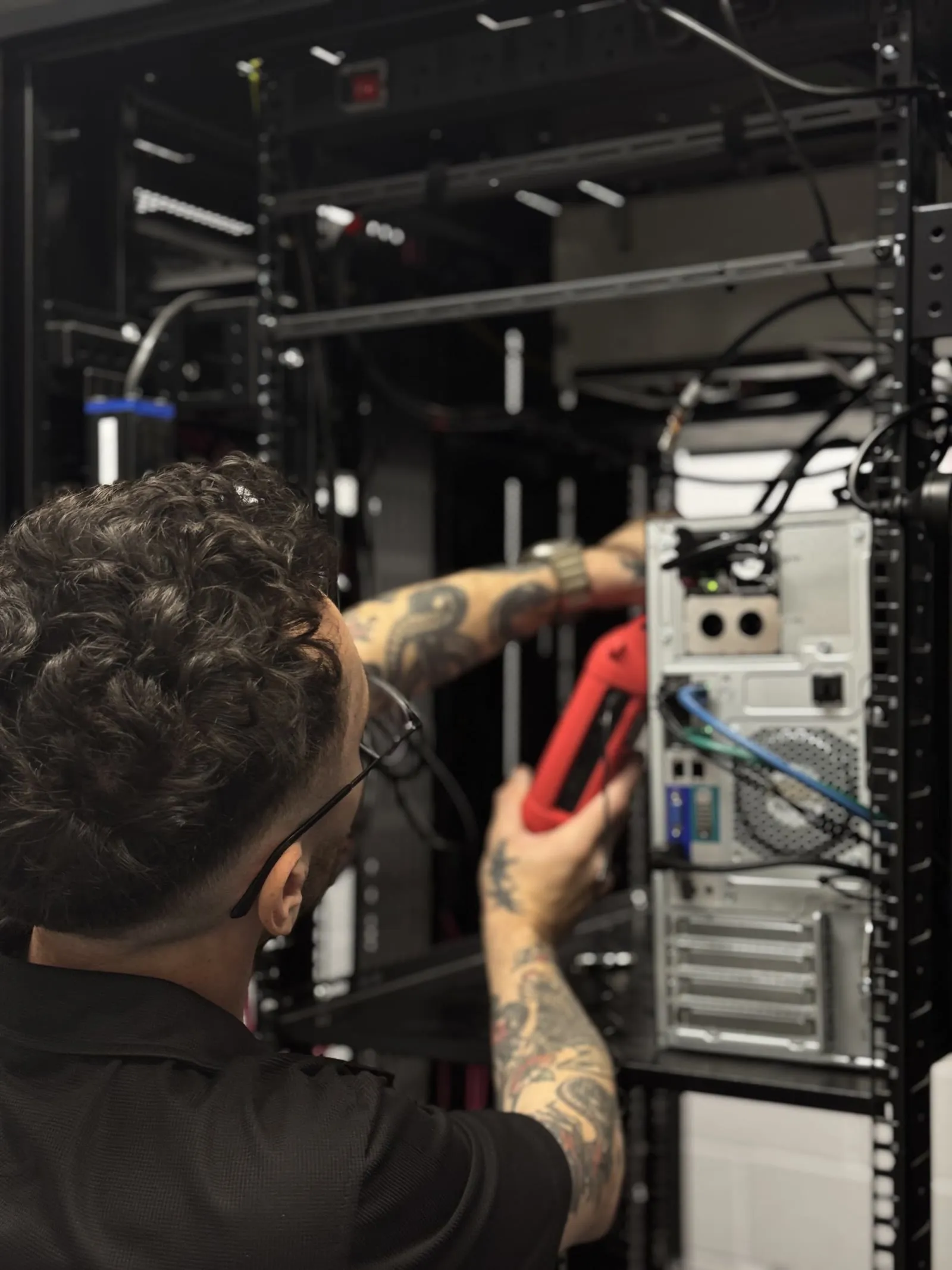
Capture the signal
It starts with a site survey, not a catalogue. We measure actual RF levels at your building, then select and aim antennas for Perth's transmitters — or satellite dishes where the site needs them. In weak-signal suburbs and shadowed sites, the antenna system is engineered to the measurement, never guessed.
Condition at the head-end
Raw antenna signal is filtered channel by channel, amplified and balanced at the head-end. Filtering strips out-of-band noise before it gets amplified with everything else; balanced gain means the outlet next to the rack and the outlet four floors up receive the same clean level. This stage is where cheap installations fail first.
Distribute through the building
From the head-end, signal travels a designed tree of trunk cable, splitters and tap-offs. Every split and every metre of coax costs signal, so the whole tree is calculated as a budget — each branch engineered to land its outlets inside the working window, with headroom for weather and ageing.
Measure at every outlet
Handover means measured proof, not a wall of TVs that happened to work that afternoon. We record signal level and error margin at the outlets, referenced against the Australian standard for cabled TV distribution (AS/NZS 1367), and leave documentation the next technician can trace in minutes.
The compliance point matters more than it sounds: digital TV fails abruptly, not gracefully. A system that measures inside the standard's window with real headroom keeps working through weather, ageing and the next broadcaster restack. A system that merely 'looks fine today' is a complaint queue on a timer.
The honest comparison
MATV vs IPTV — which does your building need?
Short answer: MATV when the building just needs reliable broadcast TV at every outlet for the lowest cost; IPTV when you need per-screen control, your own channels or serious scale. We install both, so the advice follows the building.
| MATV | IPTV | |
|---|---|---|
| Delivery | RF signal over dedicated coaxial cabling | IP streams over your existing data network |
| Adding outlets | New coax run and a recalculated signal budget | Any network point becomes a TV point |
| Per-screen control | None — every outlet carries the same channels | Full — channel, volume, power and grouping from one console |
| In-house channels | Not practical without extra head-end modulation | Native — comms, menus and dashboards sit in the lineup |
| Complexity | No network dependency — works when IT is down | Needs a managed network with multicast support |
| Cost profile | Lower up front — the value pick for broadcast-only needs | Higher up front, cheaper per screen as the fleet grows |
| Best fit | Apartments, motels, clubs, straightforward retrofits | Hotels, aged care, venues, corporate, mining villages |
If the table has you leaning towards network-delivered television — central management, in-house channels, hotel-scale fleets — the deeper dive lives on our IPTV page.
Explore our IPTV installation service
The building manager's fault-finder
Six symptoms we fix every week.
MATV faults follow patterns. If one of these sounds like your building, the diagnosis below is where a measured investigation usually lands — and every fix starts with measurement, never guesswork.
TVs pixelate on windy evenings
Likely cause
An antenna moving on a tired mount, or moisture in corroded outdoor connections shifting signal level with the weather.
The fix
Re-secure and re-aim the antenna, replace weathered fittings, and confirm level headroom so normal weather variation never reaches the cliff edge.
No signal on some outlets only
Likely cause
A starved branch of the splitter tree — often the legacy of years of ad-hoc additions that were never recalculated.
The fix
Measure back from the dead outlets to the branch point, then rebalance or re-amplify that leg against a recalculated budget.
A whole floor or wing drops out
Likely cause
One failed splitter or amplifier in the riser. In an undocumented system, finding it is the expensive part.
The fix
Systematic measurement down the riser isolates the failed device quickly — then we document the tree so the next fault takes minutes.
Picture breaks up on a few channels
Likely cause
Frequency-specific interference or a head-end filter left stale after a broadcaster retune or restack.
The fix
Identify the affected multiplex, retune and refilter the head-end, and verify error margins channel by channel at the outlets.
New outlet works, three others died
Likely cause
The classic. An unplanned splitter stole signal from everything downstream — 'just one more split' is how good systems die.
The fix
Recalculate the branch, fit the correct tap value, and restore the budget so every outlet on the leg lands back in the window.
Fine all week, dead on handover day
Likely cause
Marginal levels that sat just inside the working window until temperature, weather or one more connection nudged them out.
The fix
Marginal is the enemy — we commission with measured headroom above minimum, so the system tolerates real-world drift.
Still the right answer
Where MATV still wins.
IPTV gets the headlines, but plenty of Perth buildings are better served by well-engineered coax. These are the cases where we will genuinely recommend the antenna.
Apartments & strata buildings
Residents bring their own TVs, want the normal free-to-air lineup, and nobody needs a management console. A properly balanced MATV riser serves two hundred apartments for decades with almost no running cost — no licences, no servers, no network dependency. This is MATV's home ground, and it is not close.
Motels, clubs & smaller venues
A dozen or two screens showing broadcast TV do not justify an IP head-end. A clean antenna system, a modest amplifier and a tidy distribution tree deliver everything the building actually needs — and a country motel's night manager can power-cycle the whole system from one labelled rack.
Cost-sensitive retrofits
If the coax in the walls is sound, the cheapest good outcome is usually to keep it. Re-engineering the head-end and rebalancing the existing tree costs a fraction of new cabling of any kind — and buys years of reliable service while the building plans its next refurbishment properly.
The hybrid middle ground
Buildings in transition do not have to choose. A smart head-end like the IKUSI Flow feeds coax and IP simultaneously from one rack — broadcast TV to the existing outlets, IPTV to the refurbished wing — so the migration happens on your schedule, not the cabling's.
Budget honestly
What antenna installation costs in Perth.
Commercial MATV pricing moves on five levers. Know them and any quote — ours included — becomes easy to read.
Indicative only
As a rough Perth guide: a commercial antenna and head-end refresh for a smaller building typically lands in the low thousands; rebalancing or partially rebuilding distribution across a mid-rise usually sits in the thousands to low tens of thousands; and a full MATV design for a new multi-dwelling development scales with outlet count. Fault call-outs are quoted after measurement — which is exactly why they stay small. Every project gets a fixed price after a site assessment; these bands exist only to set the right order of magnitude.
- Outlet count
- The distribution tree is priced per branch: more outlets means more taps, more cable and a bigger amplification budget to keep every endpoint in the working window.
- Building height & layout
- Risers, ceiling access and distances drive labour. A three-storey walk-up with tidy risers installs very differently from a tower with sealed service shafts.
- Reuse vs recable
- Sound existing coax slashes cost — we test before deciding. Degraded or undersized cable forces the conversation between partial recabling and a move to IPTV.
- Head-end scope
- Free-to-air only is the simple case. Adding satellite IF distribution, Foxtel integration or hybrid IP output steps the head-end hardware up accordingly.
- Site signal conditions
- Strong-signal suburbs need modest antennas. Fringe or shadowed sites need higher-gain arrays, masthead amplification and more engineering time to hit clean margins.
What we deliver
Designed, measured, documented.
Commercial antenna systems
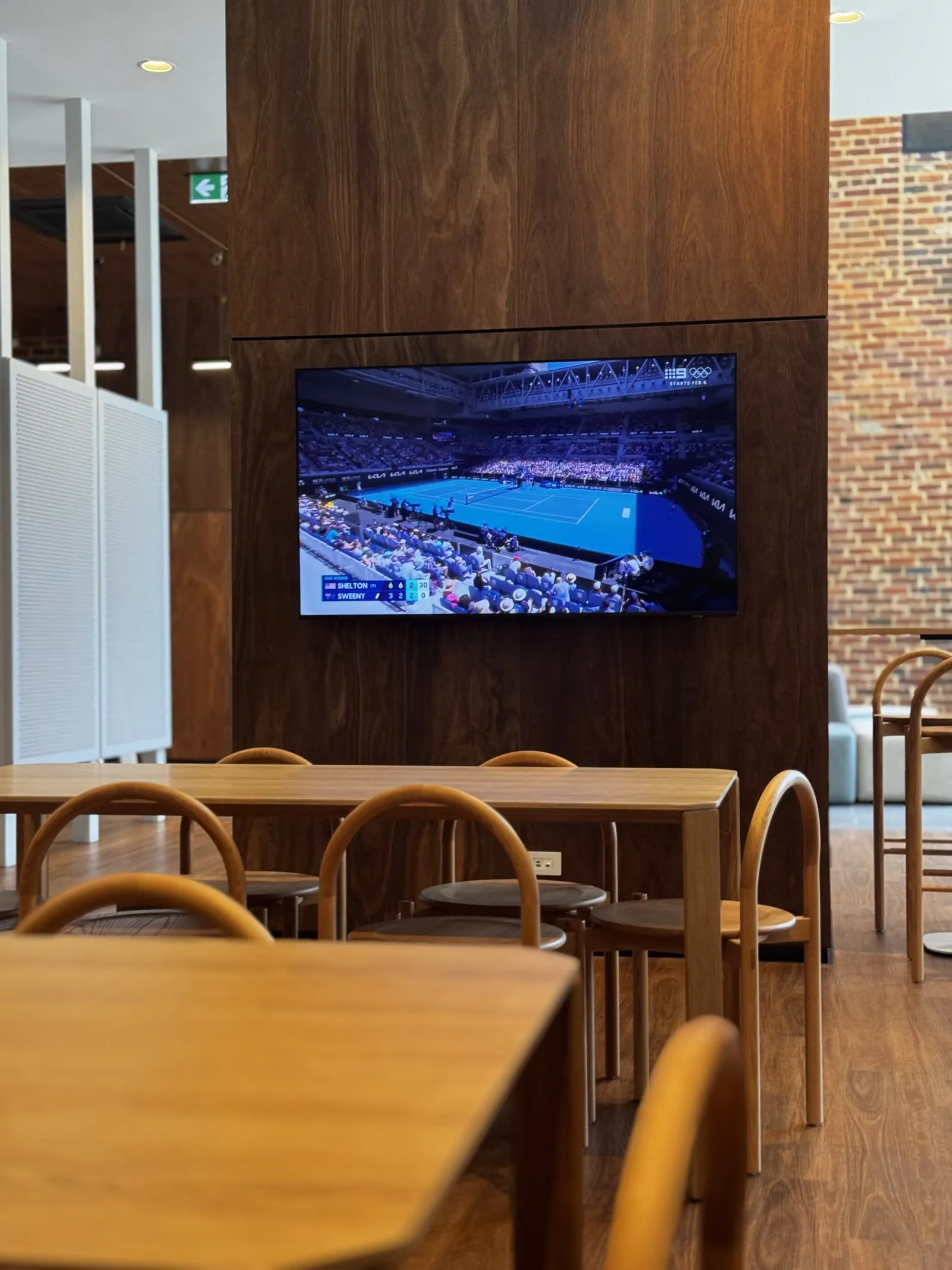
Free-to-air reception engineered for the site — the right antennas, mounting and signal path for Perth's transmitters.
Headend & amplification
Filtered, balanced amplification sized to the building — no more 'strong on level one, snow on level nine'.
Distribution design
Splitter trees and tap-offs calculated per outlet with measured signal levels at handover — not guesswork.
Foxtel & satellite integration
Satellite IF distribution and pay-TV integration alongside free-to-air where the building needs it.
Fault-finding & rescues
Systematic diagnosis of inherited systems: we measure, isolate and fix — then leave documentation behind.
MATV-to-IPTV pathways
When a building outgrows coax, we design the migration — often reusing infrastructure you already own.
Proof
Delivered. Documented.
The whole room
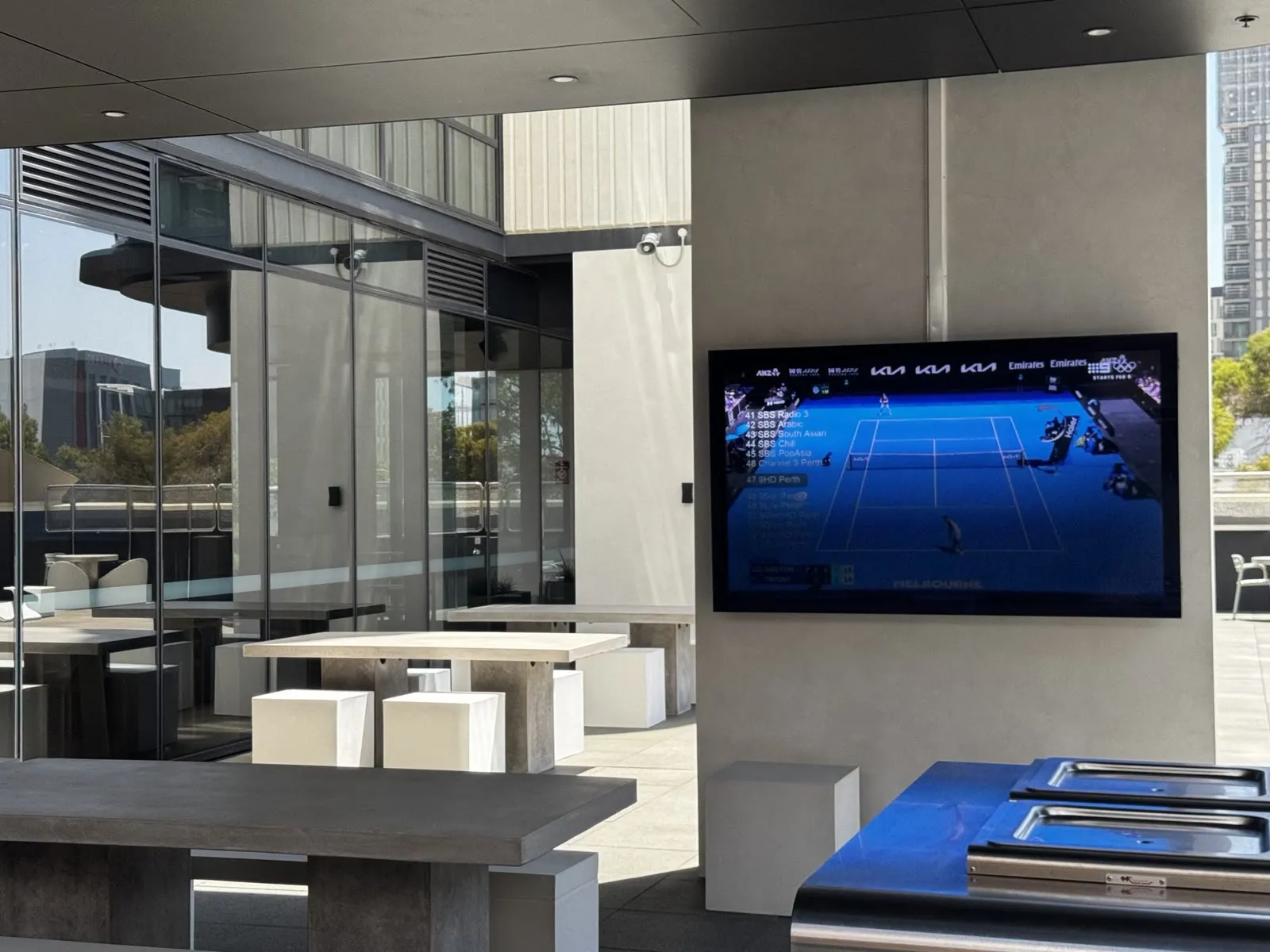
One design. One schedule. One accountable partner.
Straight answers.
MATV or IPTV for our building?
MATV wins for straightforward broadcast to many outlets — simple, robust, cost-effective. IPTV wins when you need in-house channels, per-screen control or serious scale. We install both, so our recommendation follows your building rather than our product list.
Why is reception bad on some floors only?
Classic distribution imbalance: every split loses signal, and unbalanced trees starve the far ends. The fix is measurement and redesign of the amplification and splits — usually far cheaper than the recabling someone else quoted.
Can you add outlets without wrecking the system?
Yes — but each outlet changes the signal budget, which is why 'just one more splitter' is how good systems die. We recalculate, re-balance and leave the documentation current.
Do you service strata and building managers?
Constantly — MATV health checks, fault response and upgrade planning for residential and mixed-use buildings are core work for us. One system report and the AGM questions get much shorter.
How does an MATV system actually work?
One engineered antenna or satellite head-end captures broadcast signal, filters and amplifies it, then distributes it through a calculated tree of coax, splitters and tap-offs so every outlet in the building receives a clean, measured level. The 'master antenna' does the work once, properly, instead of every TV fending for itself with its own reception.
How much does antenna installation cost in Perth?
Indicatively, for commercial work: an antenna and head-end refresh on a smaller building typically sits in the low thousands; rebalancing or partially rebuilding a mid-rise distribution system runs from the thousands into the low tens of thousands; and new multi-dwelling MATV designs scale with outlet count. Site signal conditions and building access move the number — which is why we measure first, then quote a fixed price.
Why do our TVs pixelate in windy weather?
Because something in the signal path is marginal — usually an antenna moving on a tired mount, or moisture in corroded outdoor connections. Digital TV fails abruptly once levels drop out of the working window, so a system with no headroom looks fine in calm weather and falls apart in wind. The fix is mechanical and measured: re-secure, re-terminate, and commission with genuine margin.
Do you do TV antenna installation across Perth and WA?
Yes — for commercial and multi-dwelling buildings: apartments and strata, hotels and motels, aged care, clubs and workplaces across the Perth metro area, with regional WA covered by arrangement. Single-house domestic antenna jobs aren't our focus; buildings full of outlets are.
Can an MATV system carry Foxtel or satellite channels?
Yes. Satellite IF distribution and Foxtel integration can run alongside free-to-air within the same designed system, and a hybrid head-end like the IKUSI Flow can feed coax and IPTV outputs simultaneously from one rack. It's a head-end design question — which is exactly the part we engineer first.
Signal problems in the building? We'll measure before we quote.
A proper site assessment finds the real fault — then you get a fix priced on evidence, not folklore.