A year ago today, a calendar date took more Australian meeting rooms out of service than any hardware fault of the last decade. On 14 October 2025, support for Microsoft Teams Rooms on Windows 10 ended. Microsoft’s own lifecycle documentation is unsentimental about what that means: devices running Windows version 10.0.19045 or lower must be updated to Windows 11 if they are eligible, or replaced. Several certified devices that organisations bought in good faith — the HP Slice G2 and the Crestron Skull Canyon among them — cannot be upgraded at all, and Microsoft’s guidance is to replace them.
Nothing broke. No panel dimmed, no fan seized, no capacitor let go. The compute in those rooms performed exactly as well on 15 October as it had on 13 October. It simply stopped being supported, and every one of those devices was inside a hardware warranty that had precisely nothing to say about it. That is the argument here, and it is worth stating bluntly before the evidence: a hardware warranty insures you against the least likely thing that will ever happen to your AV estate. Boxes rarely die inside their warranty period. Rooms stop working constantly, for reasons no warranty document has ever contemplated. The gap between those two sentences is what AV support in Perth is actually for, and most organisations have never bought it — they have bought a warranty, been told it was support, and found out otherwise on a Tuesday morning with eleven people waiting.
The four ways a room actually stops working
Walk any estate of twenty-odd rooms for a year and keep an honest tally of what took each room out of service. Judged by the call-outs we attend, the distribution is nothing like what the procurement paperwork assumes.
| Failure class | What it looks like in the room | Hardware warranty covers it? | Who can actually restore it |
|---|---|---|---|
| Hardware fault | A display stays black, a bar won’t power, an amplifier is silent | Yes — parts, eventually | The vendor’s returns process, then someone to fit the replacement |
| Platform lifecycle | The room works but is out of support; an app version is refused, an OS is past its date | No | Whoever owns the room’s roadmap and budgets for compute refresh |
| Licence and account | Sign-in loops, the room drops off the booking system, a management feature silently disappears | No | Whoever holds the tenant, the licence register and the resource accounts |
| Configuration drift | Audio is wrong since a firmware update, a mic pod has dropped off, a replaced switch broke something | No | Whoever holds the as-builts, the config backups and the commissioning notes |
Three of those four rows are not hardware problems, and only one of them is a warranty’s business. The industry has worked this out on its own side of the table: AVIXA’s 2026 channel survey of 202 providers found services made up 38% of their 2025 revenue, slightly ahead of hardware at 36%. The supply side has already shifted from selling boxes to selling ongoing work. The buying side, in our experience across WA, still writes tenders as though AV is a capital purchase with a five-year parts guarantee stapled to the back.
What the warranty on your audio visual equipment in Perth actually promises
Read one. They are short, and they are honest about their own limits — the misunderstanding is entirely on the buying side.
Logitech, whose hardware sits in a very large share of Perth’s meeting rooms, offers a two-year limited hardware warranty on its room systems. The remedy is set out plainly: repair or replacement at Logitech’s option, which may use new, refurbished or used parts. The extended warranty you can buy on top is exactly what its own terms say it is — a time extension of that same standard warranty, with every one of the original exclusions intact. It is a longer promise about the same narrow thing.
That is not a criticism of Logitech. It is how hardware warranties work, everywhere, and the vendors are clearer about it than the resellers quoting them. Note what the manufacturer does when it wants to sell you something that behaves like support: it sells a separate service plan, with different terms, priced separately — and even then the boundary is drawn around its own equipment. Logitech’s Select plan is explicit that third-party products are not covered. Which is a problem in a real room, because a real room is a Rally Bar and Tap bundle plus a commercial display from a second manufacturer, a Q-SYS processor from a third, a network port owned by IT, a licence owned by the tenant administrator, and a table someone from Facilities moved last month.
Four warranties, each diligently covering its own box, and not one of them covering the room.
Meanwhile the parts of the room that genuinely do fail are governed by documents nobody treats as commercial terms. Microsoft supports the current release of the Teams Rooms app and the previous major release — N and N-1. If you hit a defect on anything older, the documented fix is to install the latest version, which assumes somebody is watching version numbers across the fleet. The OS requirements move too: Windows 11 25H2 requires Teams Rooms app 5.6.210.0 or later, while 23H2 and 22H2 are listed as not supported. None of that is unreasonable for a platform under active development. All of it is a standing maintenance obligation that a warranty does not mention, a monitoring dashboard does not discharge, and a purchase order does not fund.
Licensing adds the last turn of the screw. Teams Rooms Basic is capped at 25 licences per organisation, and the capabilities an estate owner most wants — remote configuration, device analytics, custom health alerts — sit on the Pro licence. The practical effect is that the visibility you need to support a fleet properly is a subscription line item, not a property of the hardware you bought. Any serious conversation about Microsoft Teams Rooms has to include who renews that, and what happens in the room on the day it lapses.
The Three-Minute Rule
Here is the test we think every support agreement should be measured against, because it is the only one the people in the room apply.
The Three-Minute Rule: if the person standing in the room cannot start their meeting within three minutes of trying, that room is down — regardless of what the monitoring dashboard says, and regardless of whether anything in it has technically failed.
Three minutes is not arbitrary. It is roughly the window before someone gives up, walks to another room, or starts the meeting on a laptop speaker with eleven people leaning in. After that point the room has cost the organisation its meeting whether or not a single device is faulty.
Apply the rule and most support agreements read very strangely. They promise response times — a telephone answered, a ticket acknowledged, an engineer dispatched within so many hours. Those are measures of the supplier’s internal process. None of them is a measure of a working room. An agreement can be met in full while a boardroom sits dark for a week waiting on a returns authorisation, because nothing in it ever promised you a meeting.
So the clauses worth arguing over are the unglamorous ones. What counts as a room-down event, in writing, and who declares it. Whether restoration depends on the manufacturer’s returns process completing first, or whether there is loan stock and a spares holding that lets the room run on Tuesday and sort the paperwork later. Who holds the configuration backups, the as-built drawings and the commissioning file — because a support call that begins with archaeology has already blown the three minutes several hundred times over. Whether the agreement covers firmware and app versions as scheduled work rather than as a favour. And who is named, with a mobile number, for the licence and account layer, which is where a growing share of faults now live and which no AV contract traditionally touched.
That is the shape of Focus Care, and it is why we wrote it around rooms and sites rather than device lists. It also covers systems we did not install — rooms built by others and orphaned when the integrator moved on get adopted here most months, and the first job on every one of them is reconstructing the documentation that should have been handed over in the first place.
Boardroom audio visual raises the stakes without changing the engineering
The failure classes do not change as rooms get more expensive. What changes is the cost per minute of the three-minute test failing, and the number of people who witness it.
A huddle room that misbehaves is an irritation someone works around. A board meeting that cannot get its remote directors on screen is a different category of event entirely: the people in the room are the most expensive hour in the organisation, there is an agenda with legal consequences, and the technology is being judged by everyone present at exactly the moment it fails. Yet boardroom AV is routinely bought with the same parts warranty as a huddle room and no serviceability requirement at all.
Serviceability is the part that gets designed out quietly, and it is almost impossible to retrofit. At RAAFA’s Training Centre we mounted the Teams Rooms hardware on pull-out drawers specifically so a fault is a one-person job rather than a two-person lift with a 98-inch display balanced between them. That decision cost very little at install and changes every support visit for the next decade. The same logic drives the preference for appliance-based room compute such as RoomMate over a PC in a credenza: when the platform lifecycle eventually forces a refresh — and the last twelve months have proven it does — you want to replace one accessible, swappable device, not excavate a room.
Across a fleet, the pay-off compounds. The reason we push hard for one consistent platform across an estate, as we did for ECU’s collaborative spaces, is not aesthetic tidiness. It is that a standardised fleet has one version number to track, one spares holding to keep, and one set of instructions that works in every room. Twelve rooms built twelve ways is twelve separate maintenance obligations, and a support agreement priced for that honestly is expensive, because it should be.
The honest case for not buying a support agreement
There is one, and pretending otherwise is how this industry earns its reputation.
If your estate is three or four appliance-based rooms, all inside the manufacturer’s warranty, all on an identical platform, and you have an internal IT team who already own the tenant, the licences and the network — buy nothing. Hold a spare bar if the rooms matter. Pay for the occasional site visit at an hourly rate. You will be fine, and a fixed annual fee would be poor value.
The same goes for the thing that is genuinely oversold at the moment: monitoring as a product. A health dashboard is useful — it catches the silent faults, the mic pod that quietly dropped off six weeks ago, the display that stopped waking, the device three app versions behind. We use that data daily and would not work without it. But a dashboard detects; it does not restore. Monitoring sold as support is a smoke alarm sold as a fire brigade, and the distinction only ever surfaces at the worst possible moment.
The case for an agreement gets stronger with exactly three variables: the number of rooms, the number of platforms under management, and the cost of a failed meeting in your most important room. If those three numbers are small, keep your money. If any of them is large — and in most WA organisations with a boardroom, at least one is — then the question is not whether to pay for support, but whether what you are paying for is restoration or acknowledgement.
One question for the AV installers in Perth you are about to sign with
Skip the response-time table in the proposal. Ask this instead, and listen to how specifically it can be answered:
The boardroom will not start a meeting at 8:55 on a Tuesday. Nothing is physically broken — the compute is out of support, or a licence has lapsed, or an update changed the audio. Who do I ring, what do they have in their van, and what time is that meeting running?
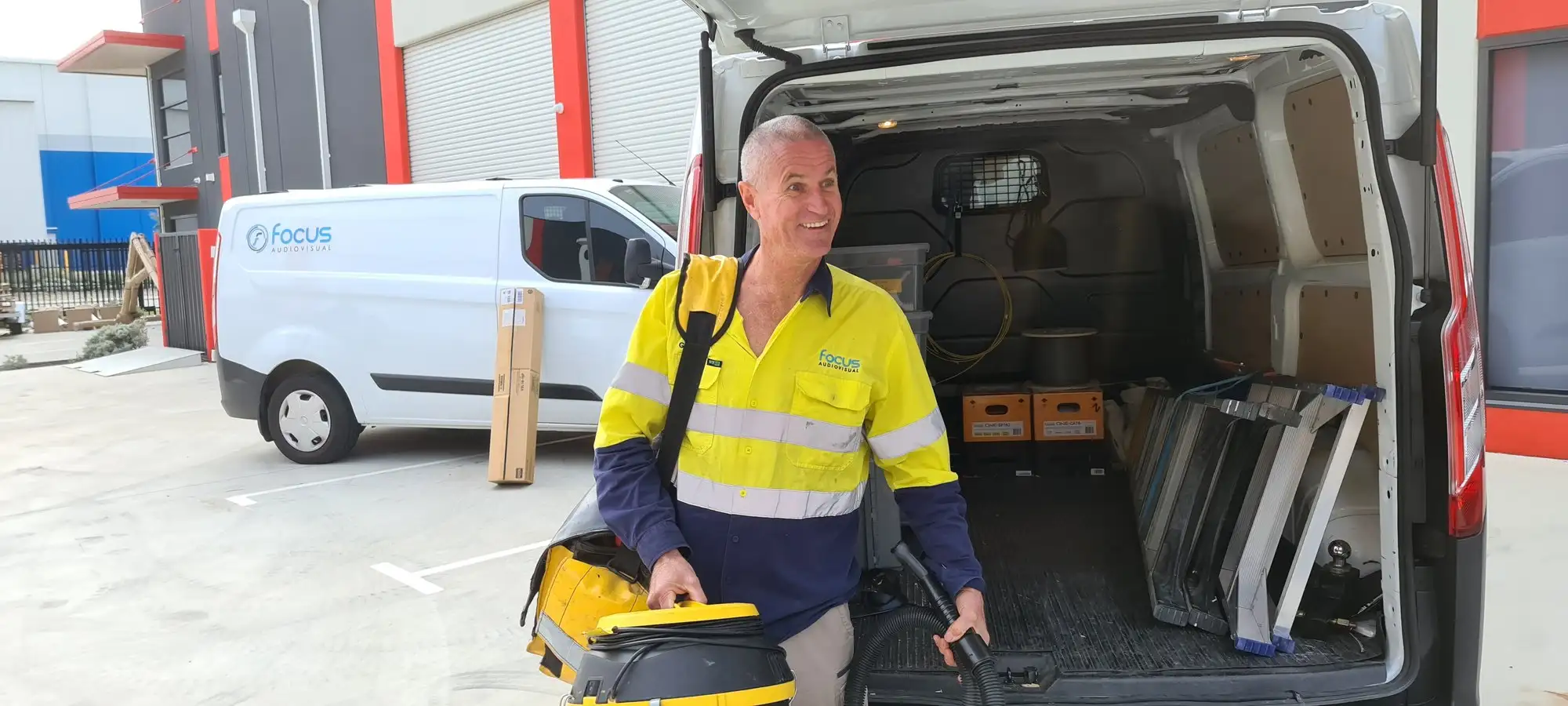
A supplier who answers with a name, a spares holding and a time is selling support. A supplier who answers with a warranty period, a portal URL or a service-level table is selling the paperwork around a box. Both are legitimate businesses. Only one of them gets your board back in front of a working screen before the agenda collapses — and in our view that distinction belongs in the design conversation, alongside display sizing and acoustics, long before it becomes a line item.
If you have an estate where nobody can confidently answer that question, start by finding out who currently owns each of those four failure classes. Then talk to us about AV support and preventative maintenance in Perth, or about what good serviceability looks like when it is designed into meeting room AV from the first sketch rather than discovered during the first fault.