The wall is six years old and it still works. That is the problem.
Stand in the foyer at nine on a Tuesday and you can see it — a square roughly 250 millimetres on a side, three modules up and two in from the left edge, running very slightly warm against everything around it. Not broken. Not black. Just not the same white. Once you have seen it you cannot unsee it, and neither can the facilities manager, who has walked past it for eleven months and now wants to know what it costs to make it go away.
That module is not a fault. It is a repair — fitted in year four after its predecessor started losing pixels — and it is the wrong colour because it is younger than its neighbours. Which brings us to the position, awkward for anybody who sells LED off a specification sheet: the numbers that decide what an LED wall looks like on day one are not the numbers that decide what it looks like in year seven, and the second set is almost never in the tender. Pixel pitch, brightness and refresh rate are day-one numbers. Service access, batch-matched spares, calibration data and a named owner are year-seven numbers. Nearly every LED screen bought in Perth is procured on the first list alone.
None of which argues against LED. It argues that the important part of LED screen design and installation happens before the structural steel is set, not after the picture comes up.
How long does an LED screen actually last?
The number everybody quotes is 100,000 hours. Run a screen twelve hours a day and that is nearly twenty-three years; around the clock, still better than eleven. Set against a building’s fit-out cycle, it sounds like a solved problem.
It is not a lifespan. It is a half-life. The industry’s rated hours come from the LM-80 method for measuring lumen maintenance of LED light sources, which describes degradation as L90, L70 and L50 — the hours until a diode falls to ninety, seventy or fifty percent of its original output. The headline figure is almost always L50: the hour at which the diode is half as bright as the day it was switched on, not the hour it stops working, and it assumes every diode is driven at rated current and rated junction temperature throughout.
Neither assumption survives a real building. Junction temperature alone moves published LED lifetimes by a factor of three between a part running comfortably and the same part running hot — and an outdoor screen in Perth is not running comfortably. Daylight legibility needs somewhere between 5,000 and 8,000 nits, where an indoor foyer wall does its job at 800 to 1,500. Same rated hours on the same brochure; several times the drive and several times the heat.
So the honest reading of 100,000 hours is this: nothing in that number promises the wall will still be uniform. It only promises the wall will still be lit.
Walls do not age evenly, and that is the whole problem
If every diode dimmed at the same rate, gradual brightness loss would be invisible — the eye adapts, and nobody notices a canvas losing two percent a year together. Walls do not, because content decides ageing. A logo locked into the top-left corner of a foyer wall, a scoreboard’s permanently-lit clock field, a menu board’s static header, a sponsor panel unchanged since commissioning: those diodes accumulate hours at high drive while the ones beside them cycle through ordinary video at a fraction of the duty. Red, green and blue emitters do not degrade at the same rate either, so what emerges is not a dim patch but a colour cast.
Heat decides ageing too, and heat is never uniform: the top of a tall wall runs hotter than the bottom, a cabinet against a power supply hotter than one that is not, a facade screen taking western sun hotter than the half in shade. Six years of that produces a gradient — exactly the artefact human vision is best at detecting.
Nobody rings us about a dark LED wall. They ring about a wall that has stopped looking like one wall.
A new module in an old wall is a visible fault
This is the part that catches organisations off guard, because it inverts the normal logic of maintenance: on an ageing LED wall, the repair is often more visible than the failure.
LED emitters are sorted at manufacture into bins by brightness and dominant wavelength, and a wall is built from a matched set of those bins. It has to be — that is what makes sixty separate cabinets read as one surface. A module ordered three years after handover comes from a different production run and a different bin, with zero hours on it. Bolt it in beside six-year-old neighbours and it is brighter, and a slightly different colour. You have swapped a dead rectangle for a glowing one.
The genuine fix is calibration. Serious LED systems store per-module and per-pixel correction coefficients — the data that pulls every cabinet onto a common target — in flash memory on the receiving cards behind the modules. In the Novastar and Colorlight toolchains that dominate the market, sending a configuration only writes it to volatile memory; it survives a power cycle only if somebody explicitly saved it to hardware. The uniformity of your wall is a file, on a card, that a specific person either owns or does not.
Two questions settle whether a wall is repairable, and both are unglamorous enough that they rarely reach a tender: who holds the calibration data, and can they re-run a calibration after a module swap? If the answer to either is a shrug, the wall is disposable and has been priced as an asset.
Which is why pixel pitch is the right place to start a specification and the wrong place to finish one. Pitch is a resolution decision, made once, from viewing distance. Uniformity is an ownership decision, made for as long as the screen is on the wall.
The Five Percent Rule
All of it collapses into one procurement instruction, cheap enough that there is no defensible reason to skip it.
The Five Percent Rule. Buy five percent of the wall’s modules as spares, on the same purchase order, from the same production batch, and store them in the building. If the spares are not on a shelf on site, you do not have spares. You have a hope.
The arithmetic is smaller than people expect. A 5-metre by 3-metre wall built from 500 × 500 mm cabinets is sixty cabinets; if each carries four 250 × 250 mm modules, that is 240 modules. Five percent is twelve modules plus a couple of spare power supplies and receiving cards — hundreds of dollars against a wall costing tens of thousands. Published guidance runs from two to ten percent; five is the number that survives contact with a real building and a real finance department.
Each condition does specific work, and dropping any one wastes the other two. Same batch, because that is the only way the spare is bin-matched to the wall it will join — a spare from a later run is a future patch, not a future repair. Same purchase order, because you are buying at wall pricing while the model still exists; a module worth a few hundred dollars on day one can be a discontinued part sourced second-hand on day one thousand. Stored on site, because failures do not schedule themselves — they happen at four on a Friday before a board meeting, and a spare in a warehouse interstate is not a spare that weekend.
Established Australian distribution matters here for exactly this reason rather than for anything on the spec sheet. It is why we specify lines like VuePix MV series LED and Absen LED displays, where spares and service are a real supply chain rather than a promise in a proposal.
The decision the builder makes on your behalf
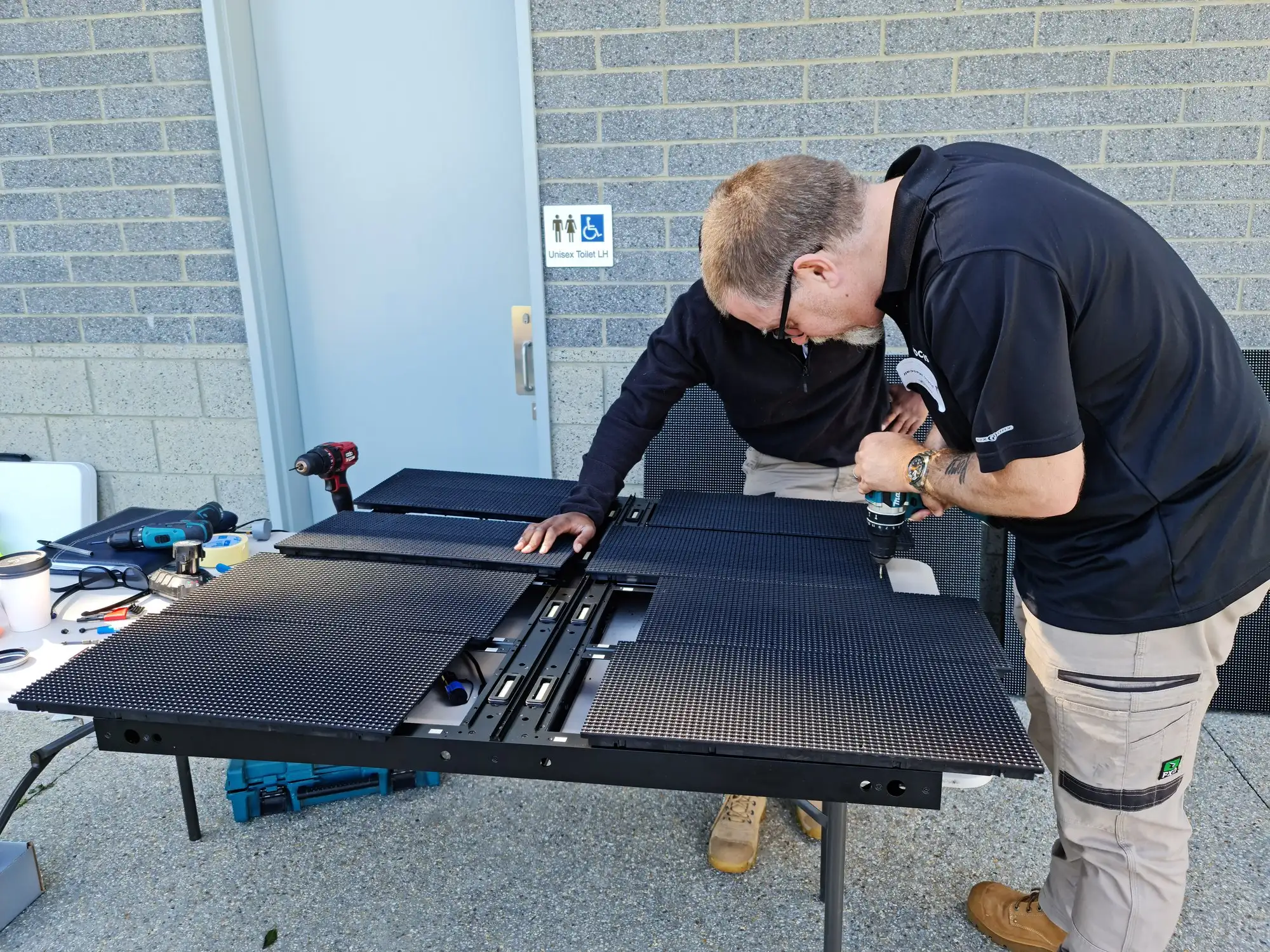
LED cabinets are either front-serviced or rear-serviced. Front-serviced cabinets let a technician pull modules, power supplies and receiving cards out of the face of the screen with a magnetic or vacuum tool. Rear-serviced cabinets are cheaper and slimmer and need a service void behind the wall that somebody can physically get into.
Neither is wrong. What is wrong — and common — is choosing one after the structure is fixed, because the maintenance decision is a structural decision: it sets whether the wall is recessed or standing off, how deep the void is, where the access panel goes. And it is locked in when the wall’s position is agreed, which on most fit-outs is weeks before the AV contract is awarded.
Get that sequence backwards and the consequence is permanent. Build a screen flush into a feature wall or onto a facade with no rear access, fit rear-service cabinets, and every service visit for the next decade needs a scissor lift or a scaffold. That recurring cost was created by a drawing, not by the hardware.
On the LED system at RAC Arena, the steel framing grid behind the finished surface was engineered before a single module was hung — on a geometry like that, access is designed in or lost forever. The same discipline applies to a ten-square-metre foyer wall; it is just easier to skip when the wall looks simple.
What LED signage in Perth has to survive
Brightness is the specification most often over-bought and least often commissioned, and in this climate it is also the one that quietly sets the wall’s ageing rate. An outdoor screen genuinely needs the nits — the working rule for daylight legibility is a face producing two to three times the luminance of its surroundings, which is how the 5,000-to-8,000 nit bracket exists at all. But nits are bought once and paid for continuously, in heat and diode hours. A 7,500-nit screen still at full output at nine at night is burning life it will never get back, throwing light at a neighbouring building and looking worse than it would at a quarter of the output.
Quality outdoor LED ships with an ambient light sensor for precisely this reason, and it is one of the most frequently uncommissioned features in the category. A tuned dimming curve is the cheapest life extension available on an outdoor screen and it comes free with the hardware — so ask for the commissioned curve in the handover pack, not just the peak figure in the proposal.
Then there is everything else Western Australia adds: IP-rated construction that holds up under summer sun and winter storms, salt air near the coast, wind loading, and a UV environment harsher than a northern-hemisphere specification sheet assumes. Sports venues cop all of it at once — the reason an LED scoreboard is an engineering job rather than a screen purchase, and the reason the outdoor screen we delivered for the Shire of Moora was specified around regional WA weather first.
The control hardware nobody asks about
The shortest commercial life in an LED system does not belong to the LEDs. It belongs to the processing.
Sending cards, receiving cards and video processors are computing products on computing product cycles. Novastar has discontinued its widely deployed MRV210-X receiving card series; its VX400 processor arrived as the successor to the very common VX4S; Linsn’s TS802 sending card gave way to the TS921. Manufacturers generally do maintain backward compatibility — but “generally” carries a great deal of weight in an asset the building intends to keep for a decade.
The exposure is not that a card fails. It is that the card fails in year nine, the replacement is two generations newer, and the calibration data that made your wall uniform was only ever held by an integrator who has since moved on. The hardware is replaceable; the commissioning knowledge is what goes missing. That is the whole reason a support arrangement like Focus Care exists — so the calibration files, processor configuration and spares register have a custodian who is not one person’s memory.
Where this argument runs out
It would be dishonest to pretend the five-percent discipline is right for every screen. If the wall is a media asset with a three-to-five-year horizon — an advertising screen expected to pay for itself and be replaced — day-one numbers legitimately dominate. Run it hard, depreciate it, replace it. Fine-pitch chip-on-board construction shifts the odds too: the emitters are better protected against handling damage and discrete pixel failures are rarer, so the patchwork risk is lower. Lower, not zero. Differential ageing does not care what the packaging is.
All-in-one LED changes the calculus most of all. When a screen arrives as a single sealed product under a single warranty — the 108-inch Samsung The Wall All-in-One being the obvious case — the spares argument transfers to the manufacturer, which is a good reason to prefer the format in a boardroom over a modular build you now have to steward yourself.
The strongest objection is the budget one. Front-service cabinets and five percent spares cost real money that could otherwise buy a finer pitch or a brighter panel. True. But the trade is not “spares or resolution”. It is “spares or a wall that looks second-hand in year six”, and there is no pixel pitch that fixes a visible patch.
Back to the foyer
The panel that started this could have been prevented by twelve modules on a shelf in the services cupboard and a calibration file with somebody’s name against it — a rounding error on the original project. What it costs now is a choice between three unattractive options: chase a discontinued module and accept an imperfect match, re-calibrate the whole canvas to bring one new module into agreement with sixty ageing ones, or leave it and let a visitor’s eye find it every morning. We have quoted all three. None is as cheap as the decision that was available on day one.
An LED wall is not a screen you buy. It is a surface you keep, and the only day whose requirements you can still influence is today. So specify it for the day somebody has to repair it: access decided before the steel, five percent of the modules bought with the wall and stored in the building, a commissioned dimming curve in the handover pack, and a calibration file with a custodian. The same principles carry across every other pixel on the site, including the commercial digital signage fleet running on the same neglected assumptions.
That is what we mean by a properly engineered large LED screen in Perth — not the brightest number on the quote, but the wall that still reads as one surface long after everybody who signed for it has moved on.