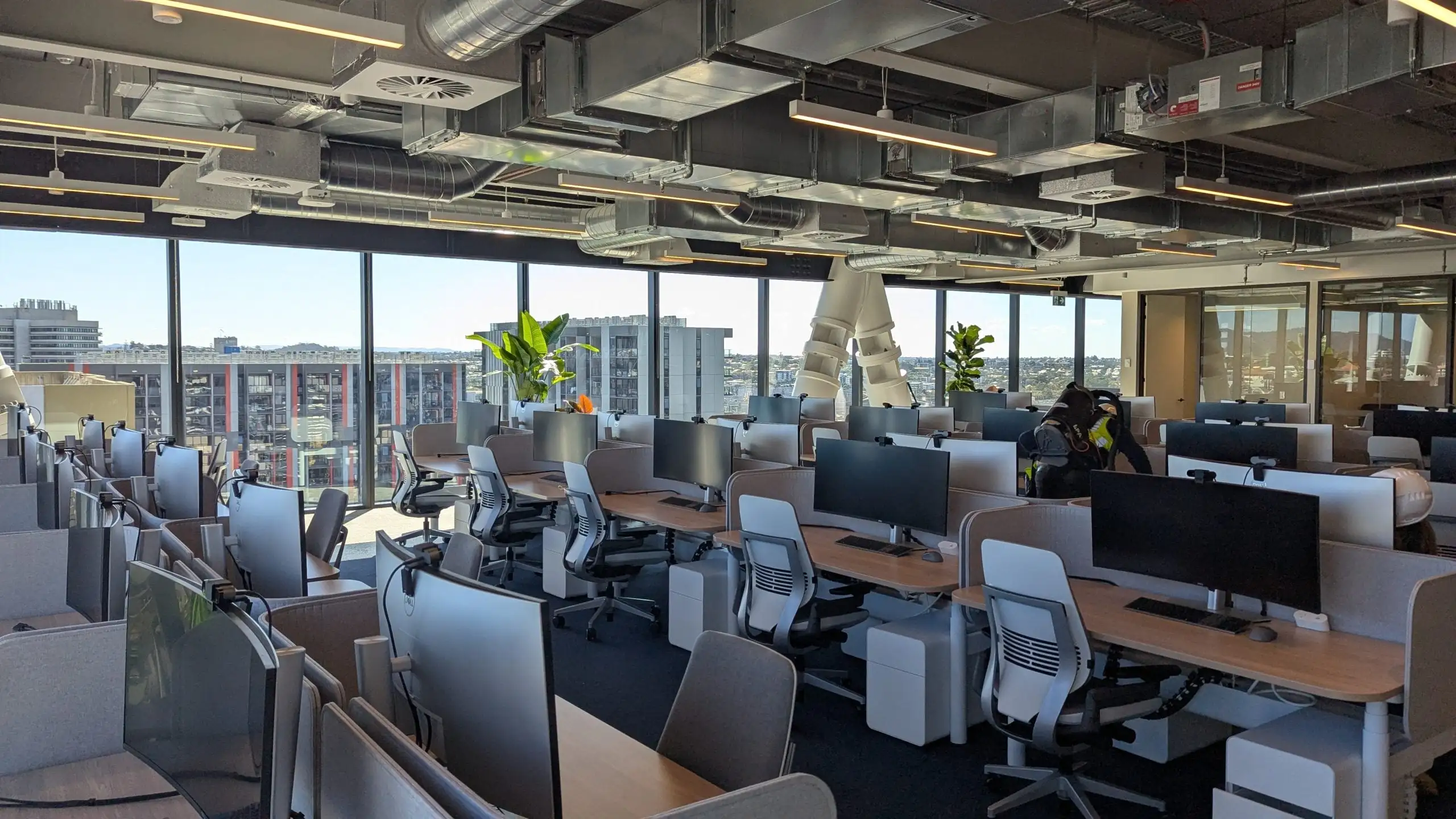
Five metres.
That is the distance the acoustics profession treats as a good result for an open-plan office — the point by which one person’s normal speaking voice should have stopped being intelligible to everyone else. ISO 3382-3, the international standard for measuring open-plan office acoustics, calls it the distraction distance: the distance from a talker at which the Speech Transmission Index falls below 0.50. Past that line you can tell someone is speaking. You cannot follow what they said. The guidance that accompanies the standard treats five metres or less as good practice, and a spatial decay rate of speech below 5 dB as a poor floor.
Hardly any Australian workplace has that number anywhere in its project file. What organisations buy instead, when the complaints reach a critical mass, is absorption — more panels, a softer ceiling, felt on the walls — and they buy it because it is the visible, quotable, easily specified item on the acoustic menu. Here is the position, and it is not a popular one with anybody selling panels by the square metre: acoustic absorption is the most-purchased and least-effective tool for speech privacy in an open-plan office. Panels change how a room sounds. They do very little about who can understand you. Those are two different problems, and the second one — the one that generates the complaints, the compliance risk and the headphones — is solved by desk-level blocking and by sound masking for open-plan offices, the two levers almost nobody buys.
The physics that ends the argument
Absorption works on sound that has hit something. A panel converts the energy of a reflection into a negligible amount of heat, which is why a treated boardroom sounds tighter, why microphones in it pick up voices rather than the room, and why acoustic treatment is genuinely essential in any space where a camera and a microphone are working. Reflections are its entire job.
Now put two people at desks six metres apart with clear line of sight between them. The speech arriving at the second desk took the shortest path available: straight through the air, hitting nothing on the way. No panel touched it. No ceiling raft touched it. The absorption in that space had no opportunity to act on the majority of the energy that makes those words intelligible, because that energy never went near a surface.
Absorption is not useless here — it does improve the spatial decay rate, the measured rate at which speech falls away as you walk from the talker, which is precisely why ISO 3382-3 bothers to measure it. But there is a ceiling on that improvement, and the ceiling is the direct path. You can line a floor plate with every product in the catalogue and the person at the desk opposite will still hear you clearly, because you are speaking directly at them.
Then there is the part nobody mentions in the proposal. Intelligibility is a ratio, not a volume: you understand speech when it arrives at your ear louder than everything else arriving with it. Absorption pulls down the reverberant field, which lowers the intruding voice and the general hum of the floor that was partly covering it — while leaving the direct path, the part you most needed to lose, exactly where it was. The floor gets quieter. The voice carrying across it gets no harder to follow. This is the library effect, and it is why organisations report that a newly treated office feels calmer and more exposed at the same time, and cannot work out how both can be true.
Absorb, block, cover
Three levers exist. They are not interchangeable, they are not substitutes, and confusing them is the single most common reason an acoustic budget produces no measurable change in how a floor feels to work on.
| Absorb | Block | Cover | |
|---|---|---|---|
| What it is | Panels, rafts, ceiling tiles, soft finishes | Desk screens, storage, height changes, real walls | An engineered masking sound, evenly distributed |
| Acts on | Reflected sound only | The direct path between two people | The listener’s background level |
| Fixes | Reverberation, harshness, microphone pickup | Line-of-sight speech at short range | Intelligibility at distance, across a whole floor |
| Cannot fix | Desk-to-desk intelligibility | A 40-metre floor plate | Echo inside a room; a wall you actually need |
| Measured by | Reverberation time, against AS/NZS 2107 | Spatial decay rate of speech, ISO 3382-3 | Masking level and spectrum, ASTM E1573 |
| Failure mode | A quiet floor where one voice carries | A maze of screens nobody wants to sit in | Set too loud or tuned badly, and everybody hears it |
The rule that falls out of the table is worth writing on the wall of every workplace design meeting: absorption changes how a room sounds; only blocking and covering change who can understand you. Nearly every open-plan acoustic complaint we are called out to look at comes from a floor where the entire budget went into the first column.
Blocking is the cheapest of the three and the most often value-engineered out. Acoustic desk screens put material directly in the direct path — the one place absorption can actually intercept it — and they do more for desk-to-desk privacy per dollar than the same money spent on ceiling rafts. They also lose every argument they have ever had with a workplace strategist who wants sightlines across the floor, which is a legitimate design position and an acoustic cost that should be stated out loud rather than discovered in year two.
Covering is the lever with no visual consequence at all, which is exactly why it gets left off drawings. Masking adds a low-level, precisely shaped ambient sound that sits where human speech sits on the frequency spectrum, delivered evenly from small emitters on a ceiling grid. It does not hide the conversation you are in — near speech stays perfectly intelligible. It raises the floor under the conversation happening fifteen metres away until your brain can no longer resolve the words. It is the only one of the three levers that scales across an entire tenancy without changing a single sightline.
Does sound masking actually work?
It is a fair question, and it deserves a better answer than a vendor’s assurance.
Masking is not experimental technology. It has been standard in North American corporate, legal and government fit-outs for decades, and it is measurable in a way that a lot of acoustic work is not: ASTM E1573 exists specifically to define how masking sound level and spectrum are measured and reported, using A-weighted and one-third-octave-band sound pressure levels, with E1041 as the companion guide for a deeper evaluation. A commissioned system is verified against a documented spectrum at a documented level, in every zone, with a class-1 meter. It either meets the specification or it does not.
The working range is narrow, and that narrowness is the whole craft. Below roughly 42 dBA masking stops doing anything useful — there is not enough of it to cover speech at distance. Above roughly 48 dBA occupant complaints start climbing, and what people complain about is exactly what you would expect: a noise. The system lives in a six-decibel window, it has to hold that window evenly across a whole floor plate with no audible steps between zones, and it has to be ramped in over several days so nobody experiences it arriving. Miss any of those and you have built the thing that gives masking its bad reputation.
That bad reputation is the honest counter-case, and it is real. Every person who has told you masking is awful has met a badly commissioned system: tuned by ear alone, set loud to prove it was working, or carrying too much high-frequency energy so the floor hisses. A masking system you can hear has failed, and those failures are common enough that the scepticism is earned. The rebuttal is not that masking is magic — it is that masking is commissioning, and an integrator who cannot show you a written report with measured levels per zone is selling you a risk.
The most convincing demonstration remains the crudest. Turn a properly commissioned system off in the middle of a working day and watch a floor of people look up within about a minute, because the office has suddenly become a place where everyone can hear everything.
The Australian complication nobody reconciles
Here is a genuine conflict that appears in Perth projects and gets resolved by whoever notices it first, which is usually nobody.
AS/NZS 2107:2016 gives a recommended design sound level of 40 dBA for an open-plan office, with 45 dBA as the maximum acceptable. A masking specification calls for something in the order of 45 to 48 dBA on the same floor. Put both documents in the same project folder and they look like a contradiction — and on more than one fit-out an acoustic report has been used to argue a masking system down to a level at which it does nothing.
They are not actually in conflict, because they are measuring different things for different reasons. AS/NZS 2107 sets design levels for building-services noise — the ambient your air conditioning, lifts and hydraulics are allowed to produce, which is an unwanted by-product to be minimised. Masking is a deliberately introduced, deliberately shaped signal with a job to do, and the standards that govern it are the ASTM masking methods, not the services criteria. But the two numbers have to be reconciled explicitly, on the drawing, by someone who understands both — because a plant-noise budget already sitting at 42 dBA plus a masking system at 47 dBA is a combined background approaching the point where people notice, and combining them by accident is how a floor ends up feeling like the inside of a duct.
That reconciliation is not a line on a shopping list. It is design work, and it is why masking belongs on the same drawing set as the mechanical services rather than bolted on after practical completion.
What the headphones are telling you
Walk any Perth floor at eleven in the morning and count the over-ear headphones. That number is a measurement too, and it is measuring something more specific than noise.
Active noise cancellation is very good at continuous low-frequency sound. It works by generating an inverse waveform, and the physics of doing that accurately runs out somewhere between 500 Hz and 1 kHz — above that, wavelengths get short relative to the distance between microphone, processor and driver, and the cancellation degrades. The octave bands that carry most of speech intelligibility are 500 Hz, 1 kHz, 2 kHz and 4 kHz. Noise cancellation does its least useful work exactly where speech lives, which is why the aircraft cabin goes away and the colleague on a call does not.
So the headphones are not solving the problem. They are trading it: a personal fix, bought by the individual, that removes the floor’s ambient hum while leaving the intelligible speech that was the actual complaint. And they do nothing at all for speech privacy, because privacy is not about what the listener wants to hear — it is about what a person three desks away can understand about a salary conversation, a client matter or a clinical detail. No headset in the building protects the talker.
A floor full of headphones is an organisation that has quietly reassigned its acoustic budget to its staff and called the matter closed.
Where masking is the wrong answer
Being straight about the limits is what makes the rest of it credible.
Masking is not the answer in a small tenancy. Below about ten or fifteen people in one room, everyone is inside the distraction distance no matter what you do, and the masking level needed to change that would be conspicuous. Buy screens and a quiet room instead.
Masking does not treat a room, and it never has. A reverberant boardroom with a glass wall and a hard ceiling will sound exactly as harsh with masking outside the door, and the microphones inside it will keep collecting the room along with the voices — the argument we have made at length in why no microphone is smart enough to un-hear your boardroom. Inside rooms you absorb, with wall and ceiling panels or a sculpted acoustic ceiling where the ceiling is the only surface available. Between spaces you cover. Different problems, different levers, same drawing.
And masking is not a substitute for construction. Where the requirement is genuine confidentiality at close range — a consulting room, an HR office, a partner’s door onto a corridor — the answer is a wall built to a rating, sealed at the head, with the ceiling plenum considered. Masking makes a good wall better and cannot rescue a bad one.
Where this actually lands
The sequence that works is unglamorous and rarely followed. Measure the floor before you spend anything, because a distraction distance and a spatial decay rate cost a day of a consultant’s time and will tell you which of the three columns your money belongs in. Block the direct paths that can be blocked without wrecking the workplace design. Cover the rest of the floor with a system that is commissioned to a documented level rather than tuned by opinion. Treat the enclosed rooms, where absorption is genuinely the right tool and where the meeting room AV design depends on it. Then decide what plant noise is doing on top of all of it, before anyone signs the mechanical drawings.
Done together, it is one design conversation. Done separately, it is three trades each solving a different quarter of the problem and one facilities manager holding a complaints spreadsheet. On Newmont’s office fitout the treatment and the masking were specified as a pair across the same floor — treatment in the meeting spaces so the microphones hear voices instead of the room, masking through the open plan so conversations stopped travelling to the next desk cluster. On Multiplex’s floor at Nine the Esplanade the rooms were standardised down to the join experience, which is the enclosed half of the same job.
Whoever owns the result in year two matters as much as the design — masking drifts if nobody re-measures after a churn, a re-partition or a ceiling change, and the system quietly stops earning its keep. That is the ordinary, unexciting work an arrangement like Focus Care exists to do.
If your office has just been softened at considerable expense and still feels like a place where everybody can hear everything, nothing was wasted and nothing was wrong with the panels. You solved the room. You have not yet solved the distance, and no quantity of felt will. That is a question of what your floor’s background level is doing, which is a design decision somebody has to make deliberately — and it is exactly what sound masking design and commissioning in Perth is for.
Measure the five metres. Then argue about the budget.