The position first, then the argument. In any building with more than a handful of screens, the television should be the least intelligent object in the system. Not the cheapest — the least intelligent. Every app, account, home screen and paired remote that lives at the edge of a venue network is a decision the organisation has quietly delegated to a device with commercial interests of its own, and every one of those decisions eventually has to be un-made by a staff member standing on a chair with a remote at six in the morning.
The industry has already conceded this argument everywhere else. Video over IP stopped being controversial some time ago; the trade press now writes about AV-over-IP in terms of operational maturity rather than adoption, and when integrators, consultants and IT teams gather at ICC Sydney for Integrate from 2 to 4 September, nobody will be debating whether the network is the right transport for video. They will be debating IGMP behaviour and channel counts. Meanwhile, television in the same buildings — the gym floor, the staff dining room, the aged-care lounge, the hotel corridor, the club’s twelve screens behind the bar — is still routinely bought one panel at a time, each with its own operating system, its own logins and its own opinions.
That is not a television system. That is a collection of televisions. A television system has a single source of truth and a way of getting it to every screen under central control, which is precisely what commercial IPTV in Perth buys you and what a wall of smart TVs cannot, at any price.
What a commercial TV distribution system actually does
Strip the marketing off and the architecture is simple. Every source the building is entitled to show — free-to-air off the antenna, Foxtel Business, a streaming service with the right commercial agreement, plus whatever the organisation makes itself — is received once, at one place, in one rack. That head-end encodes each source into a clean IP stream. The streams travel over the structured cabling and switches the building already owns. At each screen, an endpoint decodes the stream and puts a picture on the glass.
The picture is not the deliverable. Control is. Because every screen is an addressable endpoint rather than an independent appliance, someone at a desk can change the channel on the gym screens without walking to the gym, switch the foyer to a welcome loop at 5pm, mute the terrace at a moment’s notice, power the whole fleet down at midnight, or drop an in-house channel over every screen on the site during an incident. Platforms like Tripleplay, VITEC and IKUSI Flow differ in how they do it and what portal features they add on top, but all of them are answering the same question: who is in charge of what is on the screens.
In the smart-TV model, the honest answer to that question is “whoever last held the remote”. In a managed system, the answer is a named person, a login and an audit trail.
The strongest case for a wall of smart TVs
There is one, and it deserves a fair hearing rather than a straw man.
For one to four screens, in one room, showing one thing, a head-end is engineering you do not need. A commercial display with its built-in system-on-chip player, running a signage platform, is a legitimate architecture — no rack, no endpoint boxes, no second power outlet, no multicast conversation with the IT team. We have said as much in print: for a small commercial digital signage deployment, the built-in player is often the right call, with the caveat that the panel will outlive the software platform inside it and you should buy accordingly.
The second fair point is that centralisation concentrates risk. A head-end is a single point of failure in a way that twelve independent televisions are not. If the network is poorly configured — no IGMP snooping, no VLAN separation, a switch stack that floods multicast to every port — the TV system will be bad, and it will be bad everywhere at once. That is a real project risk and the reason a competent design starts with a network assessment rather than a screen schedule.
The third is cost, and it is the one that gets said out loud in meetings: consumer panels are cheap, and a streaming stick is cheaper. Nobody signs off a head-end because it is the frugal option on day one.
All three points hold. What they do not survive is scale and time. The case for the pile of televisions collapses in a specific and predictable order, and it collapses around three decisions that the television makes on your behalf.
Three decisions the television makes for you
It decides what is on screen when nobody is watching
The home screen of a modern television is advertising real estate. Every major TV operating system is subsidised by it; the hardware is priced on the assumption that the screen will earn money after it is sold. In a domestic lounge room that is a tolerable trade. In a venue it means a screen that reverts, at some unpredictable moment, to a wall of promotional tiles for content the venue does not sell, or an “are you still watching?” prompt during service, or a screensaver in the middle of a corporate event.
The same commercial logic runs deeper than the home screen. Most smart televisions ship with automatic content recognition, which samples what is on the panel — frequently including what arrives over HDMI — to build a viewing profile for ad targeting. This has moved from a privacy-blog complaint to an enforcement matter: the Texas Attorney General sued several television manufacturers in December 2025 over ACR consent, Samsung settled in late February 2026 and agreed not to collect ACR viewing data from Texans without express consent, and the actions against other manufacturers have not resolved. That is a United States matter with no direct Australian effect. The design lesson is jurisdiction-independent: the operating system inside a consumer television is running someone else’s business model on your wall.
It decides who the warranty is written for
Consumer televisions are specified for domestic duty — typically in the order of eight hours a day — and the warranty documents say so in plain language. Samsung’s Australian warranty terms define a consumer product as hardware used in a normal domestic environment rather than a commercial one. Commercial displays are the other product: usually rated for 16/7 or 24/7 operation, sold with three-year commercial warranties, designed with the thermals to survive portrait orientation and a full trading day, and fitted with the RS-232 and IP control that lets a system drive them.
Australian Consumer Law guarantees apply to goods regardless of what a manufacturer’s warranty document says, and no warranty wording overrides them. But “we will argue a consumer guarantee claim” is not a maintenance strategy for sixteen panels running fourteen hours a day behind a bar, and the practical experience of trying it — assessment, freight, the screen dark for three weeks in the meantime — is exactly the cost the cheap panel was supposed to avoid.
It decides what your licence actually covers
This is the one that turns an AV decision into a legal one. Consumer streaming subscriptions are licensed for personal, non-commercial use; Netflix’s terms are explicit that the service and its content are for personal, non-commercial use and not for public performance. A residential Foxtel subscription cannot be used to show channels in a commercial or public venue — Foxtel Business exists precisely because licensed venues need a different product with different rights.
None of that is obscure. What makes it dangerous is the architecture. When every screen carries its own apps and its own logins, added by different people over four years, nobody in the organisation can answer the only question that matters in an audit: what are we licensed to show, and on which screens? A head-end can answer it in one line, because the channel lineup is a document rather than a folk memory. Compliance stops being a matter of trusting that nobody signed a personal account into the television in the members’ lounge.
The Dumb Glass Rule: intelligence belongs in the rack, not in the bezel. Any decision a screen can make on its own is a decision somebody will eventually have to un-make with a remote — and they will be doing it at the worst hour of the worst day. Buy the dumbest television the application allows, and put the brains where you can reach them.
IPTV or MATV: what the building actually needs
Three architectures compete for the same job. They are not equally good, but they are not equally bad either, and the choice is a building decision rather than a matter of taste.
| A wall of smart TVs | MATV over coax | Managed IPTV | |
|---|---|---|---|
| Source of truth | Each screen, individually | The head-end amplifier and the coax topology | One head-end, one lineup, one dashboard |
| Changing a channel | Find a remote, walk to the screen | Physically at the screen | From a browser, per screen or per group |
| Adding screen number 20 | Another panel, another account, another remote | A new coax run, splitters, signal budget re-checked | An endpoint and a patch lead |
| Your own channels | Not really — a second device per screen | No | Yes — corporate comms, menus, wayfinding, sponsor loops |
| Licensing position | Distributed and largely unauditable | Clear, but limited to broadcast | Documented in the lineup |
| Failure mode | Silent and per-screen; you find out from a customer | Degradation across a leg or a branch | Central and visible; monitored and alarmed |
| Where it genuinely fits | One room, one source, few screens | Buildings that need reliable broadcast TV at every outlet and nothing more | Buildings where screens outnumber the people who look after them |
Two questions settle it in most cases. Do you need per-screen control or channels of your own? And will the screen count keep growing? Two yeses point to IPTV. Two noes usually point at MATV done properly at a materially lower cost — and an integrator who installs both should be willing to say so. The failure we see is not organisations choosing MATV when they should have chosen IPTV. It is organisations choosing neither, then discovering three years later that they have accumulated forty independent televisions and no system at all.
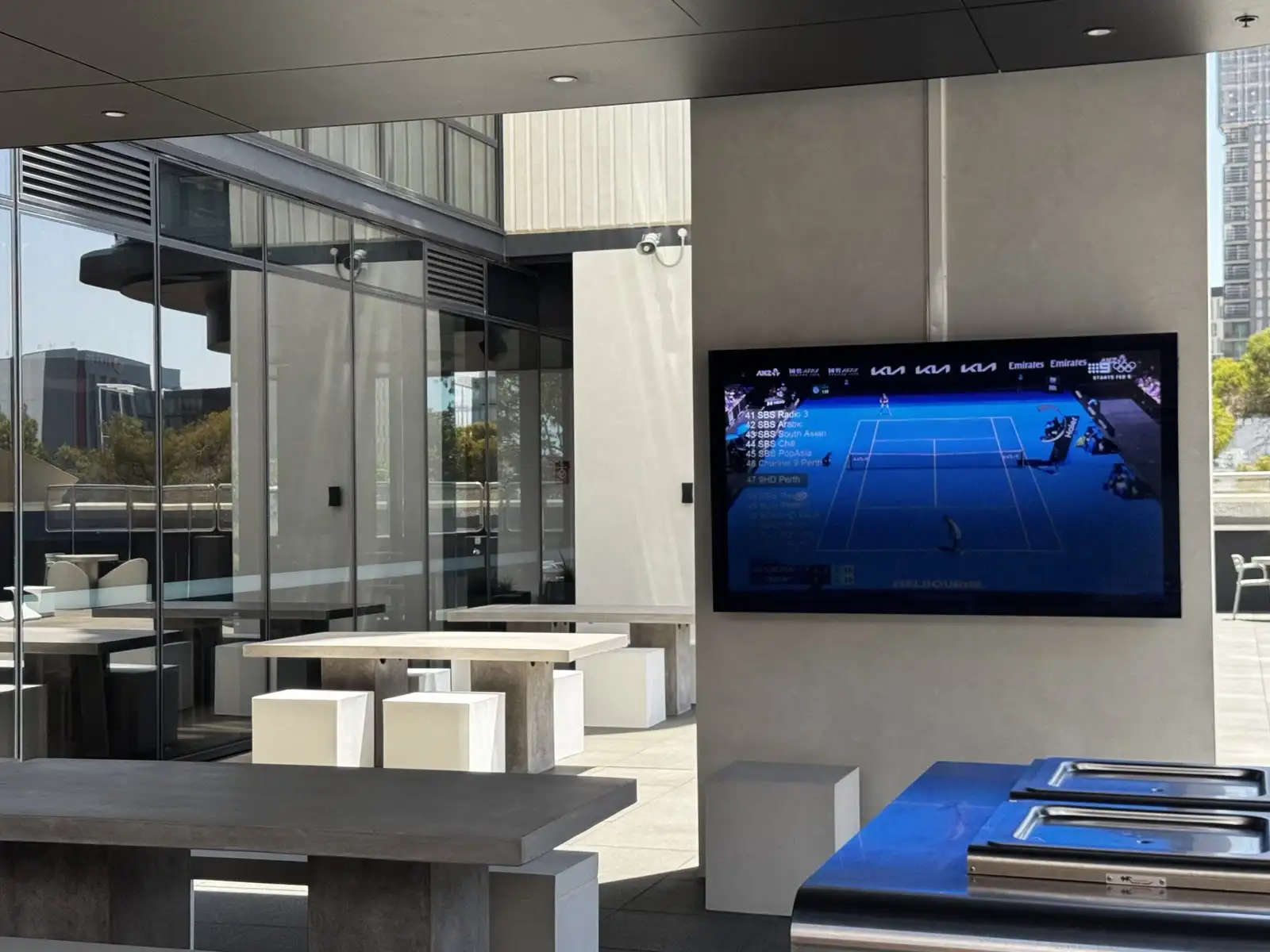
The buildings where this bites hardest are the ones with dispersed screens and dispersed staff. On a commercial IPTV installation in Perth, dining rooms, lounges, terraces and a tenant gym all run from a single head-end, which is the only reason the terrace can show the tennis while the dining room shows the news without anyone hunting for a remote. In aged care the argument is sharper again: at Brightwater Care Group the system runs IPTV into more than 120 resident rooms and eleven common areas from one head-end, because nobody was ever going to walk 120 rooms to change a channel lineup. Television there is not decoration; it is a daily service, and a set that has wandered off to its own home screen instead of the midday news is a support call from a staff member who has better things to do.
Six questions before you hang another television
None of these are about the panel. That is the point.
- Who changes the channel, and from where? If the honest answer involves finding a remote and walking somewhere, you do not have a system. Ask it about the screen that is hardest to reach — the one above the bar, or on the terrace, or in the corridor at the far end of the wing.
- What is on that screen at 6am, and what is on it when the source drops? A managed endpoint fails to a known state — a holding channel, a logo, a black screen. A smart television fails to its own home screen, which is somebody else’s advertisement.
- What are we licensed to show, and on which screens? If nobody can answer without walking the building and checking each set, the architecture has already made a compliance decision for you.
- How many hours a day will it run, and what does the warranty say about that? Multiply by 365 before you compare prices. A consumer panel at fourteen hours a day is being asked to do roughly double its design duty.
- What does screen number 20 cost? Not the panel — the account, the remote, the mount, the software licence, the person who now has to remember it exists. The marginal cost of a screen is the number that separates the two architectures, and it is almost never on the quote.
- Who owns this in year two? Someone will need to add a channel, replace an endpoint, patch a head-end and check the antenna after a storm. If that person is not named, it is nobody, and it becomes whoever is standing closest when a resident or a customer complains. That is the entire reason a support arrangement like Focus Care exists.
If a design cannot answer all six, the problem is not the budget. It is that the system was specified as a shopping list of screens rather than as a distribution system that happens to end in screens.
The cable is already in the ceiling
Here is the part that makes the whole argument cheaper than it sounds: in almost every commercial building we walk into, the hard part is already installed. The structured cabling is in, the switches are in, the risers are in, and they were paid for by somebody else’s budget line. What is missing is a head-end and the decision to stop treating each television as a self-contained appliance.
Screens are the commodity in this equation. Glass gets cheaper every year, panels get replaced on their own schedule, and the specific model on the wall matters far less than the industry’s marketing suggests. The system — the sources, the lineup, the licensing, the control, the person who owns it — is the part that either exists or does not, and it is the part that determines whether a building’s televisions are an asset or a standing irritation. That is the work in an IPTV and MATV system design, and it is the reason the smartest thing in the room should be the rack.
Buy the dumbest television the application allows. Spend the difference on knowing what is on it.