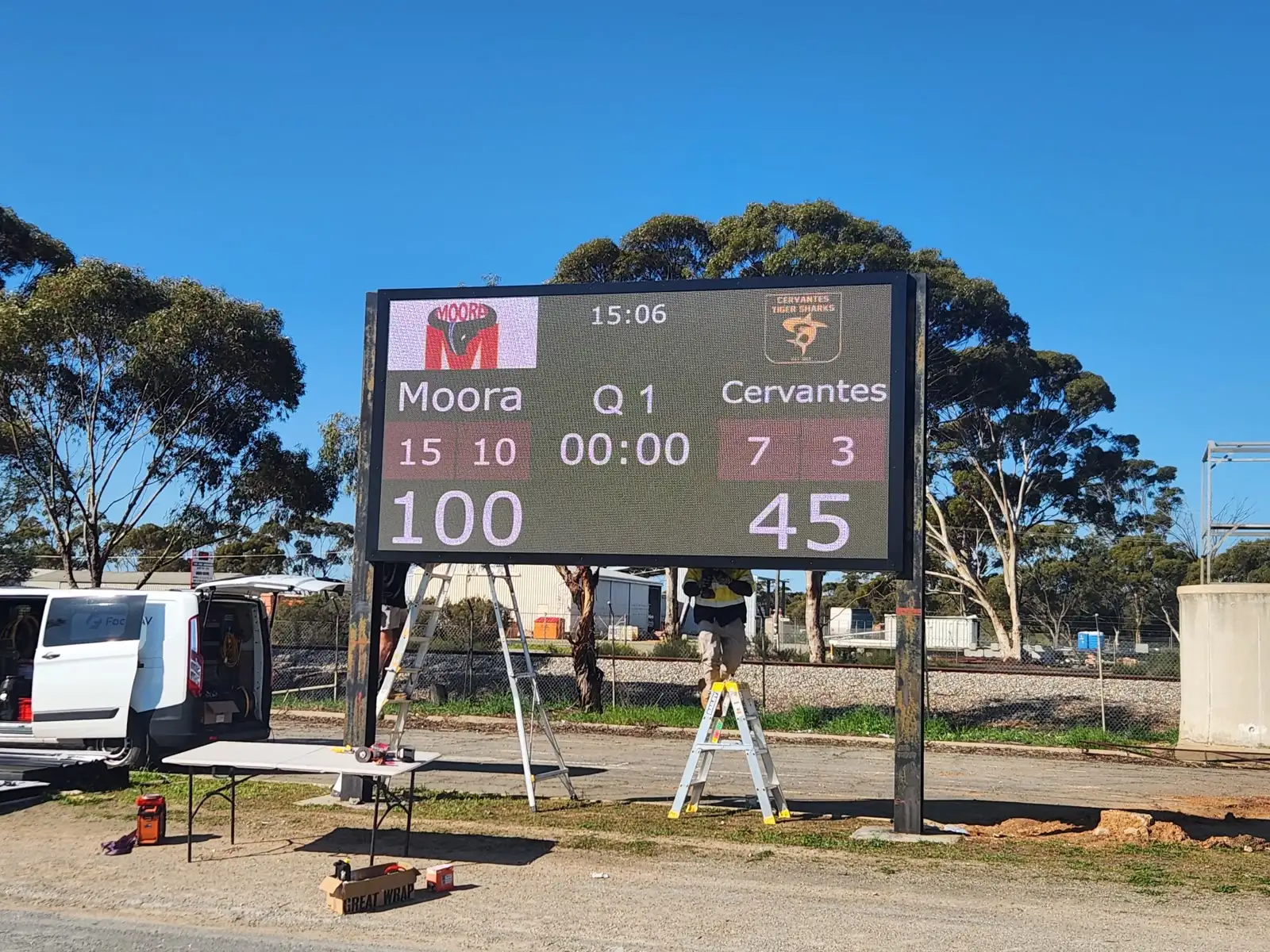
Open any scoreboard quote and count the things that get specified. Screen dimensions. Pixel pitch. Brightness in nits. Ingress rating. Cabinet depth, panel weight, warranty term, structural certification, sometimes a refresh rate. Every one of them measurable, every one comparable across three quotes on the same spreadsheet.
Now count the lines describing the person who will operate it. Usually none. Occasionally one, near the bottom, reading training to be provided at handover.
That gap is the whole argument. A scoreboard is the only large display a club or a shire owns that is operated, every time it matters, by somebody who does not work in AV, was not there when it was commissioned, and has nobody to ring at ten past one on a Saturday. The panel decides how the board looks. The operator decides whether it gets used at all — and by year three, whether it gets used properly is the only question anyone still asks.
So specify the operator first. Everything on the spec sheet is downstream of that decision, including the parts that feel like the real engineering. This is the half of LED scoreboard design and installation that never fits in a comparison table, which is exactly why it disappears from the ones that get sent out.
What the specification leaves out, and the grant paperwork doesn’t
There is a reasonable explanation for why scoreboard specifications look the way they do. Screen attributes can be compared. Operability cannot, at least not by a procurement process that has to defend its choice to a council. A number goes in a column; a judgement about volunteers does not. So the document fills up with the things that can be tabulated, and the thing that determines the outcome is left to a handshake at handover.
The pressure is about to get worse, not better. AVIXA’s 2026 industry trends list names immersive displays and video walls as a growing presence across classrooms, boardrooms and retail, crediting improving technology and falling costs. Extend that to sport and the same thing happens: more organisations than ever end up owning a large screen while having nobody on staff whose job is to drive one. The same trend list treats remote monitoring, cloud management and proactive maintenance as design properties worth having, on the grounds that they cut the number of times somebody has to get in a vehicle. That logic is obvious in a corporate fleet. It is more obvious at a regional ground, where every diagnosis needing a person on site costs a day and a vehicle.
Here is the part that should embarrass the industry. When a WA community scoreboard is part-funded through the Community Sporting and Recreation Facilities Fund, as many are, standard grants are capped at one third of the total estimated project cost excluding GST, and applications are lodged with the local government, rated and ranked by council, and only then forwarded to the department. To get that money, applicants work through the department’s Management Plan Guide, which asks for an asset inventory, building and equipment maintenance schedules, documented procedures for rectifying faults, plant and equipment replacement schedules, an organisational structure and performance indicators.
Read that list again and compare it to the AV specification the grant pays for. The funding body wants to know who runs the asset, who fixes it, and what happens when it breaks. The technical document, written months later by people who know far more about screens, frequently does not raise the subject. The grant application is more honest about operations than the specification it funds.
The Saturday Morning Test
We use a blunt test on scoreboard designs, and there is no technology in it at all. The Saturday Morning Test: a scoreboard passes if a person who has never been shown the system can do all seven of these within twenty minutes, alone, on a phone they already own.
- Wake the board — without a key, a laptop, or a call to whoever has the key.
- Reach the controller — without installing an app, creating an account, or waiting to be added to something.
- Start the right sport — correct scoring layout, correct period structure, no manual.
- Correct a wrong score — without resetting the game to do it.
- Sound the siren on demand, from the same screen they are scoring on.
- Put the sponsor content up in the breaks the sponsor was sold.
- Hand the whole thing over mid-game to a second person who has also never seen it.
Six is the one that quietly pays for the board. Seven is the one everybody skips, and it is the one that decides whether the system survives a committee turning over.
A board failing three of these still works. It simply gets used at a fraction of what it cost, and the failure never produces a complaint, because nobody experiences it as a fault. The tell is visible from the boundary: a nearly new LED screen showing the club crest for the whole match while the score is kept on the old manual board underneath it, because the crest is the last thing anyone was confidently shown how to put up. Software rescues on boards we did not install are routine work for us, and the hardware is often not the reason we were called.
The deeper point is that every item on that list is a procurement decision, not a training problem. Whether the controller needs an app is decided when the control system is chosen. Whether a wrong score can be corrected without a reset is decided by the software. Whether a second person can take over mid-game is decided by whether the design assumed one trained operator or any adult with a phone. None of it can be retrofitted with a better handover session.
Three classes of electronic scoreboard, three different seasons
Most WA clubs are really choosing between three things, and the honest difference between them is not resolution. It is what each one demands from the organisation for the next decade.
| Fixed-digit board | Score-only LED | Full video LED | |
|---|---|---|---|
| Who can run it | Anyone who finds the switch | Anyone handed the link | Someone shown how, each time |
| Match day needs | Nothing | A charged device | A device, plus content prepared in advance |
| Typical failure | A digit stops lighting | Nobody knows the login | Last season’s sponsors, all season |
| Annual commitment | Replace a failed segment | A pre-season check | Content, a roster and a budget |
| What it earns | Nothing | Sponsor panels between play | Sponsor loops, replays, presentations |
The right answer moves with the club, not with the budget. A club with a ground manager and a media-savvy junior committee can run the third column, and is the kind of club that turns it into sponsor revenue. A club whose canteen roster is a group chat should buy the second and spend the difference on the structure, because the structure is the part that cannot be upgraded later.
Which is not an argument that the panel engineering is negotiable. Outdoor screens in this state have nowhere to hide: the sun sits on the face of the board for most of a winter afternoon, and an indoor panel repurposed outdoors is unreadable at noon no matter how good its specification sheet looked. The outdoor panels we put on WA grounds are chosen for full sun and full weather — VuePix MV series cabinets, rated by the manufacturer at up to 8,000 nits with IP65 ingress protection, on the soccer and football boards; Absen outdoor cabinets at Moora; Aurora where an Australian-engineered cabinet suits the site. Get that wrong and no amount of operator-friendly software saves you.
Pitch is the number people argue about longest and the one that matters least on a scoreboard, because the closest spectator is across a boundary line rather than across a foyer. The Shire of Moora board is 4,480 by 2,240 millimetres at 6.66 millimetre pitch, which is generous for a ground that size, and a number that falls out of a viewing-distance calculation rather than a preference. The scoring interface is the part that deserves the longer conversation, because that is where the club’s actual experience of the board lives.
Mobile scoreboards move the operator problem rather than removing it
Trailer-mounted screens look like the answer for associations running sport across several reserves, and often they are. One screen serves every venue, it tows in and levels up, and the same scoring software follows it around.
What mobility also does is multiply the number of different people who will ever drive the thing. A fixed board might be run by two volunteers all season. A travelling board meets a new roster at every venue. When we built the mobile scoreboard for Volleyball WA, the specification said it had to work at a beach tournament one weekend and an indoor stadium the next, across a season running February to September — and, explicitly, that it had to be operable by whoever was rostered on that day rather than only by a trained technician. Control runs from a smartphone anywhere with a view of the court. That requirement did more to shape the design than the panel choice did.
The score buzzer is not an accessory
Ask a committee what the scoreboard must do and somebody will mention the siren within thirty seconds, because the siren is the part players respond to. Ask an integrator, and it can end up as a line item near the bottom.
If the siren lives in a separate box with its own button, under a desk, on a different power point, then at some point in the season it will not sound — not because it failed, but because the person running the score did not know it was their job. Scoring, clock, siren and sponsor content belong behind one interface, on one device, or you have designed a system with a hole in it that only shows up in front of a crowd.
The ground’s audio deserves the same scrutiny as the screen. A siren has to reach the far goal without flattening the houses over the fence, which is a coverage and level problem rather than a volume one, and it is far cheaper to solve while the cable route to the board is still open.
Our own answer to the control half of this is Buzzer, built in Perth: scoreboard control that runs in the browser on any mobile device, with no app to install, so any committee member’s phone becomes the controller and nobody has to be added to anything first. That last detail sounds trivial. It is the difference between passing and failing items two and seven above.
Where the big video board genuinely earns it
The counter-case is real, and integrators who wave it away have not sat in the room when a club works out what a screen can bring in.
A video-capable board does change a ground. Sponsor loops before the first bounce, replays that keep people at the fence, naming rights on the structure itself — clubs that get this right fund the asset out of what the asset sells. Telling every community club to buy the smallest thing that works would cost some of them real money.
There are also organisations for which specifying to the least-capable operator would plainly under-build the venue. Elite training grounds, larger stadium operations and any site with paid facility staff or a media roster can run content properly every week, and they should buy the board that lets them. The question is never whether anyone at the club wants a video board. It is whether there is a named person with the time to feed it, every week, for eight months, and whether that person’s departure is survivable.
There is one asymmetry worth holding onto when the two arguments collide. A control system that turns out to be too simple can be upgraded in an afternoon. A structure that cannot carry a larger screen cannot be upgraded at all without starting again. Engineer the structure for the board you might grow into; specify the software for the operator you actually have.
What to write down
Five clauses, added to any scoreboard specification, do more for the outcome than another round of panel comparison.
- Control from a browser, on a device the club already owns. No dedicated laptop, no app install, no account creation before someone can start a game.
- Training at handover for at least three people, with a one-page crib sheet that stays at the ground and a recording that survives the committee.
- Mid-game handover as an acceptance criterion. If a second person cannot take over the controller without a phone call, the system is not finished.
- Remote access for whoever supports it, so a fault is diagnosed before anyone drives out to look at it, and a software problem never becomes a site visit.
- A pre-season check in the calendar, not in goodwill. Panels, power, spares and software, tested before round one, under a support agreement such as Focus Care rather than whenever somebody remembers.
None of that is exotic, and none of it appears in most tenders.
The panel is the part of the project that gets photographed, and it deserves the engineering attention it gets — the structure, the certification, the brightness, the ingress rating, the spares on a shelf. But the board still being run properly in five years is not the one with the finest pitch. It is the one whose specification named a person, described what that person would be able to do unaided on a Saturday morning, and then tested it before anyone signed the handover. That is the standard we hold ourselves to on electronic LED scoreboards for WA clubs and venues, and it is the question worth asking of anyone quoting you: not how bright the screen is, but who is running it in round three next year, and what happens when they move house.